
Shopify App Pricing Benchmarks: Competitor Comparison
Pricing shapes Shopify app visibility before revenue—freemium and trial-led models boost installs, accelerate reviews, and raise conversions.
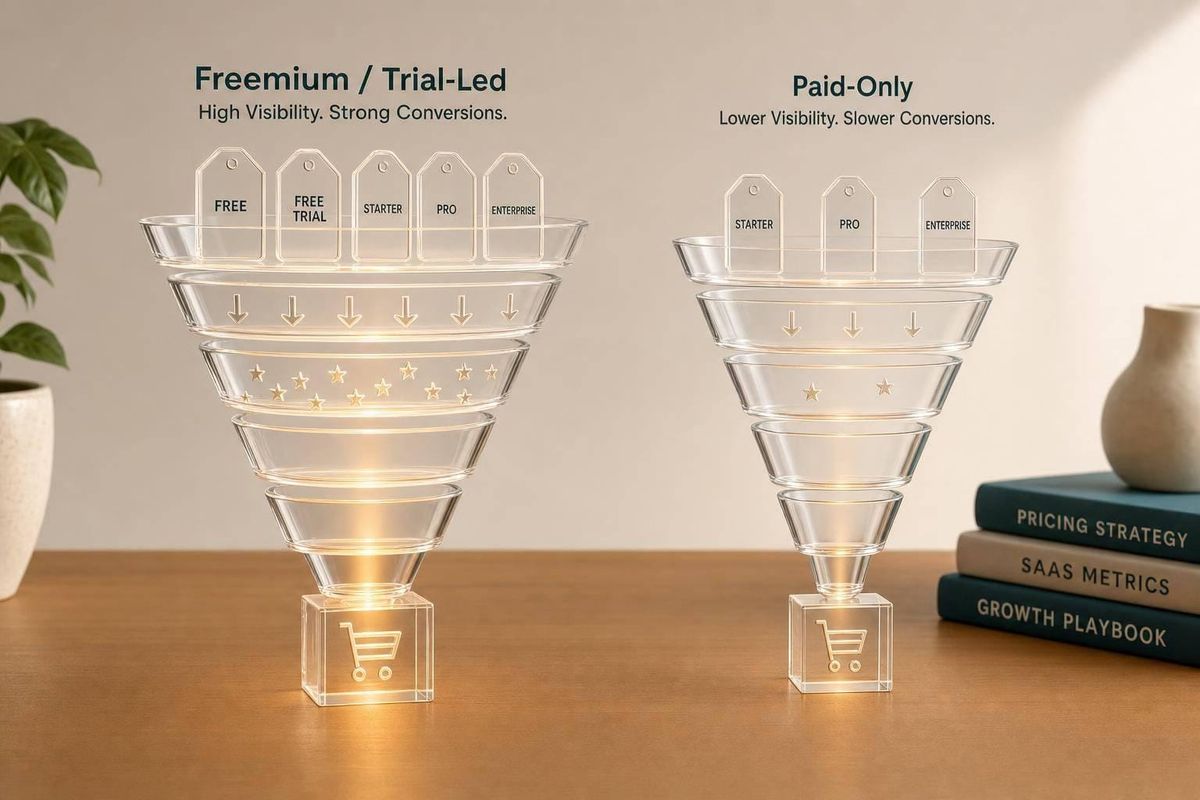
Price affects more than revenue in the Shopify App Store. It can shape installs, review speed, ranking, and paid conversion. In this piece, I compare five app categories plus AppJubilee to show where pricing starts, how pricing models differ, and where the biggest gaps show up.
If I had to boil the article down to a few points, it would be this:
- Lower entry prices often help apps get more installs.
- Freemium plans tend to reach 50 reviews sooner than paid-only apps.
- Trial-led pricing often works well when merchants need to test the full product before paying.
- Higher-priced apps can still convert if the ROI is easy to see.
- Built for Shopify and review velocity matter a lot in crowded categories.
This article covers:
- AppJubilee
- Reviews and UGC apps
- Page builder apps
- Loyalty and rewards apps
- Subscription billing apps
- Upsell and personalization apps
The main takeaway: if your price is too high for your category, installs may drop. If it is too low, merchants may doubt the product. The best pricing model usually sits between easy entry and a clear upgrade path.
Free vs Paid Plan - The Best Pricing Strategy for Shopify Apps #shopifyapp #shopify
sbb-itb-ce93587
Quick Comparison
| Subject | Typical Entry Point | Common Pricing Model | What Price Tends to Affect Most |
|---|---|---|---|
| AppJubilee | $49/month after trial | Trial-led, tiered SaaS | Team expansion and multi-app tracking |
| Reviews and UGC | $15–$20/month | Freemium, tiered | Installs, review growth, social proof |
| Page Builders | $14.99/month entry; $29–$59/month core range | Freemium or trial-led tiers | Install flow and feature gating |
| Loyalty and Rewards | Low-cost or free entry | Freemium, usage-based, tiered | Upgrade path and merchant LTV |
| Subscription Billing | Free, low monthly fee, or revenue share | Freemium, trial-led, transaction-based | Trial-to-paid rate and churn control |
| Upsell and Personalization | Free trial or low flat fee | Trial-led, freemium | AOV lift versus monthly cost |
A few numbers stand out right away:
- Shopify App Store apps active in July 2026: 17,891
- Apps using freemium: 6,147
- Free apps: 2,139
- Median time to 50 reviews for freemium apps: 407 days
- Median time to 50 reviews for paid-only apps: 624 days
So if you want the short answer, here it is: pricing shape often affects visibility first, then monetization. The rest of the article breaks down how that plays out by category.
1. AppJubilee
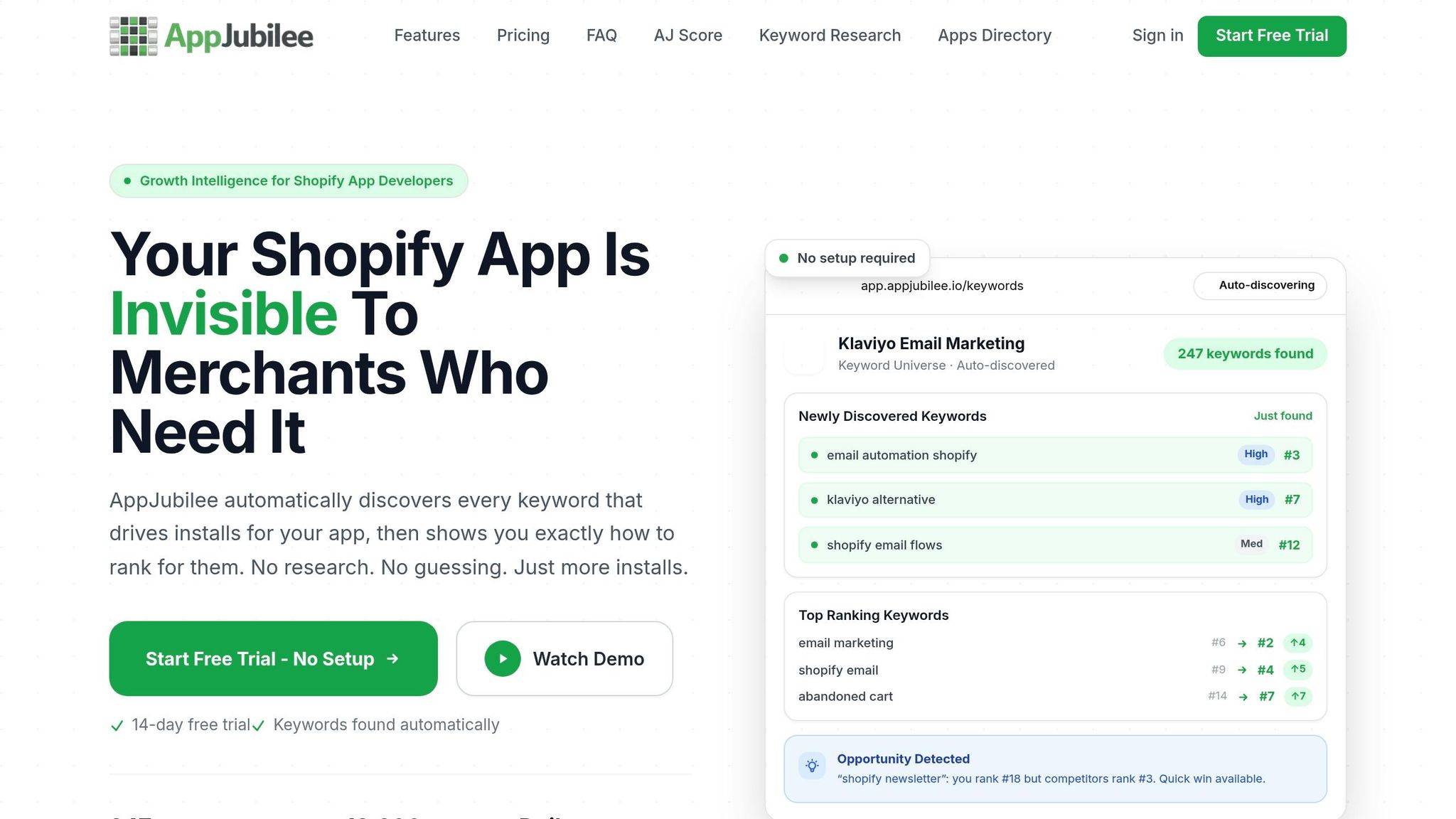
AppJubilee is a Shopify App ASO platform built for developers. In plain English, its pricing fits teams that need to watch a portfolio of apps, not merchants managing a single storefront. That makes it a useful baseline for the pricing comparisons below.
Pricing Model
AppJubilee uses a trial-led, tiered SaaS model. New accounts get a 14-day free trial, then move into one of four paid plans based on portfolio size and team size: Starter ($49/month), Growth ($99/month), Pro ($199/month), and Agency ($499/month). If you pay annually, you save about 17% compared with monthly billing.
| Plan | Price/Month | Apps Tracked | Competitor Watches | Team Members |
|---|---|---|---|---|
| Starter | $49 | 1 | 1 | 1 |
| Growth | $99 | 3 | 3 | 2 |
| Pro | $199 | 8 | 8 | 5 |
| Agency | $499 | 30 | Unlimited | 10 |
Entry Price Gap
The $49 Starter plan is the first paid tier after the trial. It includes keyword tracking, competitor mapping, listing-change impact analysis, and review tracking for one app. Those aren't vanity metrics. They're the signals teams use to understand rank movement and how a listing may affect conversion.
Visibility Signals
AppJubilee tracks daily keyword ranks, listing-change impact, review impact, and ad activity.
Conversion Potential
The 14-day trial makes it easier for buyers to test the product before paying. As you move up the pricing ladder, the plans add more tracked apps, more competitor watches, more team seats, plus integrations and API access.
2. Reviews and UGC Apps
Reviews and UGC apps usually sell through free, freemium, trial-led, or tiered plans. At the low end, Judge.me starts at $15/month. At the high end, platforms like Okendo and Yotpo go past $299/month, with enterprise deals above that. For SMBs, $15–$20/month is the main benchmark. That pricing spread matters. Lower starting prices tend to lead to faster installs, and more installs often shape review velocity.
Pricing Model
The most common setup is freemium with trial-led upgrades. Many apps keep a free plan in place to cut install friction, then put features like photo and video reviews, automated email requests, and Google Shopping syndication behind paid tiers. Volume-based pricing can also get expensive fast during peak periods. If a store has a seasonal spike, overage fees can jump hard - Okendo's overages can run at roughly 2x the normal per-credit rate. That kind of setup can change how fast an app picks up users, reviews, and search momentum.
Visibility Signals
Lower entry pricing tends to increase installs, and that feeds review velocity. Review velocity matters because the Shopify algorithm favors apps that keep gaining new reviews over apps that have big but flat totals. An app that picks up around 50 reviews in 30 days can outrank an older app with a much larger but static review count.
Higher pricing is easier to justify when the product opens up more advanced features, such as:
- visual UGC
- moderation
- localization
- bundled loyalty tools
Conversion Potential
Visibility helps, but only if the pricing path turns that attention into paid use. Free plans lower friction. Trials often do a better job when merchants can test the full product instead of a stripped-down version. Free or low-cost entry works best when merchants see results fast, then run into a clear reason to upgrade for automation, design, or scale.
A PowerReviews study found that product pages with 1–10 reviews convert at 52%–55% higher rates than pages with none. Pages with 101+ reviews see conversion lifts above 250%.
3. Page Builder Apps
Entry pricing usually starts around $14.99/month, but the main battle happens in the $29–$59/month range. That’s where most serious buyers tend to shop, because it’s the point where using the app across multiple pages starts to make sense.
At the low end, budget picks like Beae start at $14.99/month. On the other side, Replo opens at $99/month. So while page builders can look cheap at first glance, the part of the market that matters most sits in that middle band.
Pricing Model
Most page builders use a freemium model with tiered page limits and feature gates. In plain English: merchants can try the editor for free, but only up to a point.
Leading apps usually offer a permanent free plan capped at one published page. That gives merchants enough room to test the builder without paying upfront. It’s a simple setup, and it helps these apps drive installs and collect reviews fast.
Once users move to paid tiers, they get more published pages plus access to A/B testing, analytics, and conversion tools. Shogun leans more on trials, while PageFly and GemPages use free plans as the main way to bring in new users.
Visibility Signals
PageFly leads this category on visibility. Review counts are cited at 5,773 to 10,000+, with a rating around 4.9/5. GemPages comes next with 4,500+ reviews at about the same rating. Shogun sits closer to 4.0/5 with roughly 3,200+ reviews.
That gap matters. More reviews usually mean more visibility, especially when an app has broad free access. A free plan gets merchants in the door, but the listing only pulls its weight if the pricing ladder makes the next step feel obvious. Regular pricing updates can help keep a listing looking current, too.
Conversion Potential
A common play here is simple: keep the free plan tight, then put the money-making features behind paid tiers. That usually means limiting published pages on free plans, then gating A/B testing, analytics, and conversion widgets once merchants want more room to grow.
Above $59/month, apps like Shogun and Replo start aiming at enterprise and DTC use cases. At that level, price alone doesn’t do the selling. Merchants will often lean toward the app with the stronger market position and more familiar name. The same pricing logic shifts again in loyalty and rewards apps.
4. Loyalty and Rewards Apps
Loyalty and rewards apps compete on two fronts: the starting price and how much more you get as you move up.
At the lower end, plans usually stick to the basics, like Points and Referrals. Paid tiers go much deeper, with features such as VIP tiers, Loyalty analysis, Cohort analysis, and POS rewards. Bigger merchants often need LTV tracking and custom rewards, and those tools usually sit on higher-tier paid plans. That creates a clear split: easy entry on one side, heavier retention tools on the other.
Pricing Model
Freemium is still common. But trial-led plans now set the bar for conversion because merchants want to test full-feature access before they pay.
Lower starting prices can drive more installs, and more installs often lead to more reviews and better listing momentum. Smaller merchants often begin with freemium plans to launch simple refer-a-friend programs. Larger stores tend to move into paid tiers once they need deeper features, such as AI-powered rules or loyalty analysis.
Visibility Signals
In this category, review velocity matters more than total review count. An app that gains 50 reviews in 30 days can outrank a competitor sitting on 500 stale reviews.
Featured apps in the loyalty space average 20+ new reviews monthly, and about 98% of featured apps have the "Built for Shopify" certification. Without that badge, reaching top-10 visibility is rare.
Once an app earns visibility, pricing needs to make the jump from basic rewards to higher-value retention features feel worth it.
Conversion Potential
This pricing ladder works best when it's easy to understand. Apps that keep deeper features behind paid plans often convert better when the free or trial version is still useful on its own. Updating pricing, screenshots, or copy every 30 to 60 days can signal active product work and help protect ranking momentum.
That same pricing pressure shows up again in subscription billing, where revenue-linked plans make conversion even more important.
5. Subscription Billing Apps
Subscription billing shrinks the room for pricing mistakes. Merchants tend to buy only when the upside for recurring revenue is easy to see. AppJubilee tracks 258+ subscription apps, and 147 of them rank for "subscriptions". In a packed category like that, entry pricing can make or break traction.
Pricing Model
Subscription billing apps often rely on freemium, trial-led, or tiered pricing. Many also add usage-based or transaction-based fees that grow with merchant volume. A lot of apps use 14-day full-feature trials to lower friction before a merchant commits.
Seal Subscriptions starts with a free-for-life plan, then moves merchants up through tiered pricing. Verified Subscriptions uses a different setup: 1% + $0.20 per transaction, with the fee dropping as merchant revenue grows. Instead of charging mainly for access, it charges more in line with scale.
That choice shapes more than revenue. It also affects how fast an app gets reviews and how often shoppers see it in the category.
Visibility Signals
Freemium apps reach 50 reviews in a median of 407 days, while paid-only apps take 624 days. In a crowded space, lower entry pricing helps shorten the path to a first review.
Built for Shopify certification matters here too. 98% of featured apps have it. That's a strong trust signal when merchants are comparing similar tools side by side.
Once an app gets more visibility, the next hurdle is simple: does the monthly fee feel worth it?
Conversion Potential
Merchants pay when the app shows a clear link to protecting recurring revenue. That can mean cutting churn, recovering failed payments, or making renewals stick. If the app does that well, even a $100+/month price can still convert.
The ratings data backs that up. Apps priced in the $10–$30/month range average 4.71 stars, while apps at $100+/month average 4.69 stars. So the gap is tiny. Merchants will pay at both ends of the market when the ROI is easy to understand and the upgrade path feels simple.
6. Upsell and Personalization Apps
This category gets judged fast on revenue impact. If pricing doesn’t show a clear lift early, merchants won’t stick around. The space covers thank-you page upsells, frequently bought together recommendations, cart upsells, and one-click upsells. These apps win or lose on immediate revenue lift, so price gaps matter most when they change trial signups or paid conversion.
Pricing Model
In upsell and personalization, the market is moving toward trial-led pricing. These apps tend to convert better with a 14-day trial than with a limited free plan because merchants want to test the full product, not a locked-down version.
Visibility Signals
Visibility in this category depends less on low entry price and more on Built for Shopify certification and review velocity. Built for Shopify certification is basically a must-have: 98% of featured apps have it, and only 1,443 apps across the entire store have earned it. Apps without that badge rarely break into the top 10.
For new upsell apps, 10+ reviews in the first 30 days is the floor for getting search traction. An app that picks up 50 reviews in 30 days can outrank another app sitting on 500 stale reviews. Merchants also upgrade when an app shows measurable AOV lift, so proof of performance matters just as much as certification if you want to stay visible.
That same trust signal shows up at conversion too. Merchants still weigh the app’s price against the order lift they expect to get.
Conversion Potential
Once an app gets visibility, the next hurdle is simple: is the fee low enough to feel justified by immediate AOV lift? Conversion gets better when merchants can test the app’s full value before paying. Trial-led pricing beats a restricted free plan because it removes feature gates during the test period. Apps that use AI-powered personalization are also growing faster, as long as they fix a clear merchant pain point.
How Pricing Gaps Affect Visibility and Conversion
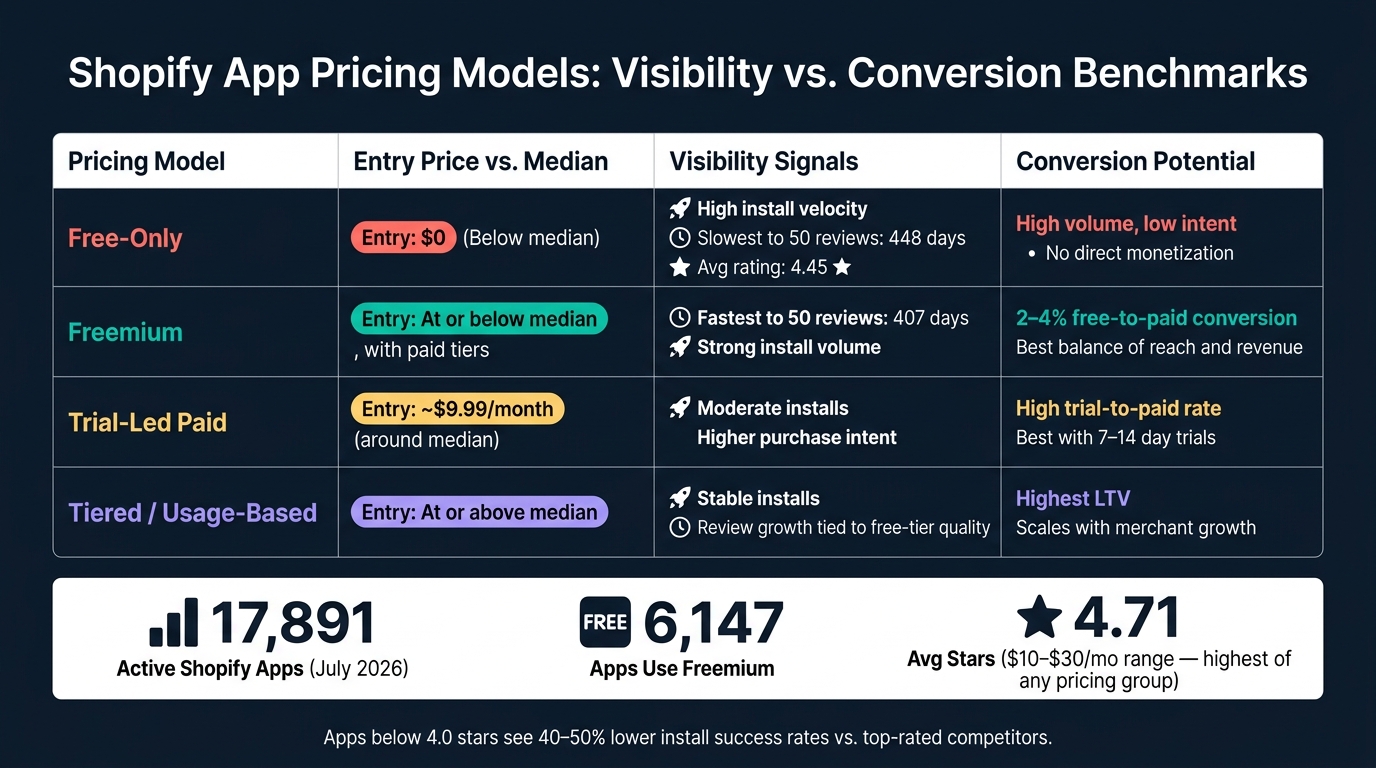
Shopify App Pricing Models: Visibility vs. Conversion Benchmarks
Across the categories above, the pattern is pretty clear: pricing shape shifts usually hit installs first, then review speed, then conversion.
That makes pricing one of the clearest levers for visibility and conversion. In a Q2 2026 dataset of 24,681 active apps, free-only apps averaged 4.45 stars, while apps in the $10–$30/month range averaged 4.71 stars - the highest average rating of any pricing group. And once an app drops below 4.0 stars, install success rates tend to fall by 40%–50% compared with top-rated competitors.
Freemium apps also reach 50 reviews faster than other models. The median time is 407 days, compared with 448 days for free-only apps and 624 days for paid-only apps. The reason is simple: freemium keeps friction low, but it still gets merchants into the product in a way that leads to actual use.
Most paid apps start below $20/month, with a median entry price around $9.99. At lower price points, installs tend to go up, but churn rises too. At the other end, apps priced above $100/month still average about 4.69 stars, which shows that premium pricing can still hold strong ratings.
Here’s how the main pricing models tend to affect visibility and conversion:
| Pricing Model | Entry Price vs. Median | Visibility Signals | Conversion Potential |
|---|---|---|---|
| Free-only | Below ($0) | High install velocity; slowest to 50 reviews (448 days); lowest average rating (4.45) | High volume, low intent; no direct monetization |
| Freemium | At or below median, with paid tiers | Fastest to 50 reviews (407 days); strong install volume | 2–4% free-to-paid conversion; best balance of reach and revenue |
| Trial-led paid | Around the median (~$9.99) | Moderate installs; buyers with stronger purchase intent | High trial-to-paid conversion when the trial is 7–14 days |
| Tiered or usage-based | At or above median | Stable installs; review accumulation tied to free-tier quality | Highest LTV; scales with merchant growth |
The tradeoff stays the same across categories. Lower friction tends to drive more reach. Tighter gating tends to improve monetization.
AppJubilee can track whether pricing changes shift installs, review velocity, and keyword rank.
Conclusion
Free and freemium models tend to drive installs and speed up review growth. Trial-led and tiered plans usually do a better job of turning users into paying customers and lifting LTV. In practice, price shapes visibility first and conversion second. The best model comes down to the category you're in and what buyers expect.
Price should line up with the value you can show. If you're far above the category median and can't clearly explain why, installs will usually drop. Go too far below the norm, and buyers may read that as a sign of limited value or weak scale. That concern shows up fast in categories like Subscription Billing, where dependability matters, and Loyalty & Rewards, where merchants often compare apps against known leaders. The aim isn't to be the cheapest or the most expensive. It's to sit at a price point that matches the proof behind your product.
Use the table below as a starting point for setting price by category and growth stage.
| Category | Early-Stage | Scaling | Mature |
|---|---|---|---|
| Reviews & UGC | Free or freemium | Tiered by review volume and features | Premium tiers with advanced UGC and support |
| Page Builder | Trial-led, modest entry | Tiered by pages, testing, and performance | Higher tiers for brands and complex workflows |
| Loyalty & Rewards | Freemium, basic points | Tiered by active members and integrations | Enterprise-like tiers with multi-channel support |
| Subscription Billing | Low entry or developer-friendly tier | Usage- or revenue-linked tiered pricing | Premium, reliability- and compliance-focused tiers |
| Upsell & Personalization | Free or low flat fee | Usage- or AOV-impact-based tiers | Usage-based or revenue-share tiers |
These are starting points, not fixed tiers. Pricing should be tested and adjusted as install, conversion, and churn data comes in. AppJubilee can help teams see whether a pricing change affected keyword rankings, install velocity, or review activity. That makes it easier to tell if a new price changed rankings, installs, or reviews. Its competitor alerts and listing change impact tracking also help teams spot when a rival changes pricing and whether that move is picking up momentum.
The best price earns installs and supports upgrades.
FAQs
How do I know if my app is priced too high?
Compare your conversion rate with similar apps. If your listing gets lots of clicks but not many installs, that usually points to a gap between what your keywords hint at and what your app delivers in price or features.
With AppJubilee, you can stack your pricing and offer next to top-ranking apps in your category. If conversion is slow, take a close look at whether your price lines up with the intent behind your target keywords and where your listing appears.
Should I choose freemium or a free trial?
Put the focus on a free trial. A 14-day free trial often converts better than a limited free plan because merchants usually want to try an app’s full feature set before they pay.
A lot of apps lean on freemium models. But an unrestricted trial tends to line up better with what merchants want. It lets them see the app in action, without hitting limits too early, and makes the app’s value easier to spot. That can lead to higher conversion rates.
When should I raise my app price?
Consider increasing your app price when AppJubilee data shows steady keyword rankings and strong install velocity. That usually points to solid demand.
If your app stays near the top for core, problem-based, or vertical-specific keywords, the market has already shown that users see the value. Test higher pricing tiers, then watch daily ranking snapshots to make sure visibility and conversions hold up.