
Free Trial Length: Does It Impact Installs?
How trial length affects installs, engagement, and conversions—align duration with time-to-value and test to boost LTV.
Yes, free trial length impacts installs, engagement, and conversions - but not in a one-size-fits-all way. The right trial duration depends on your app’s complexity and how quickly users experience value. Here’s what the data says:
- Short trials (3–7 days): Boost adoption by 11%, but 55% of users cancel on Day 0 or Day 1.
- Medium trials (14 days): Balance adoption and conversion, especially for apps needing setup time.
- Long trials (30 days): Signal quality but risk procrastination; 51% of users cancel by the end.
Key takeaway: Align trial length with your app’s time-to-value. For Shopify apps, start with 14 days, test different durations, and track metrics like retention and lifetime value (LTV). Tools like A/B testing and cohort analysis can help refine your strategy.
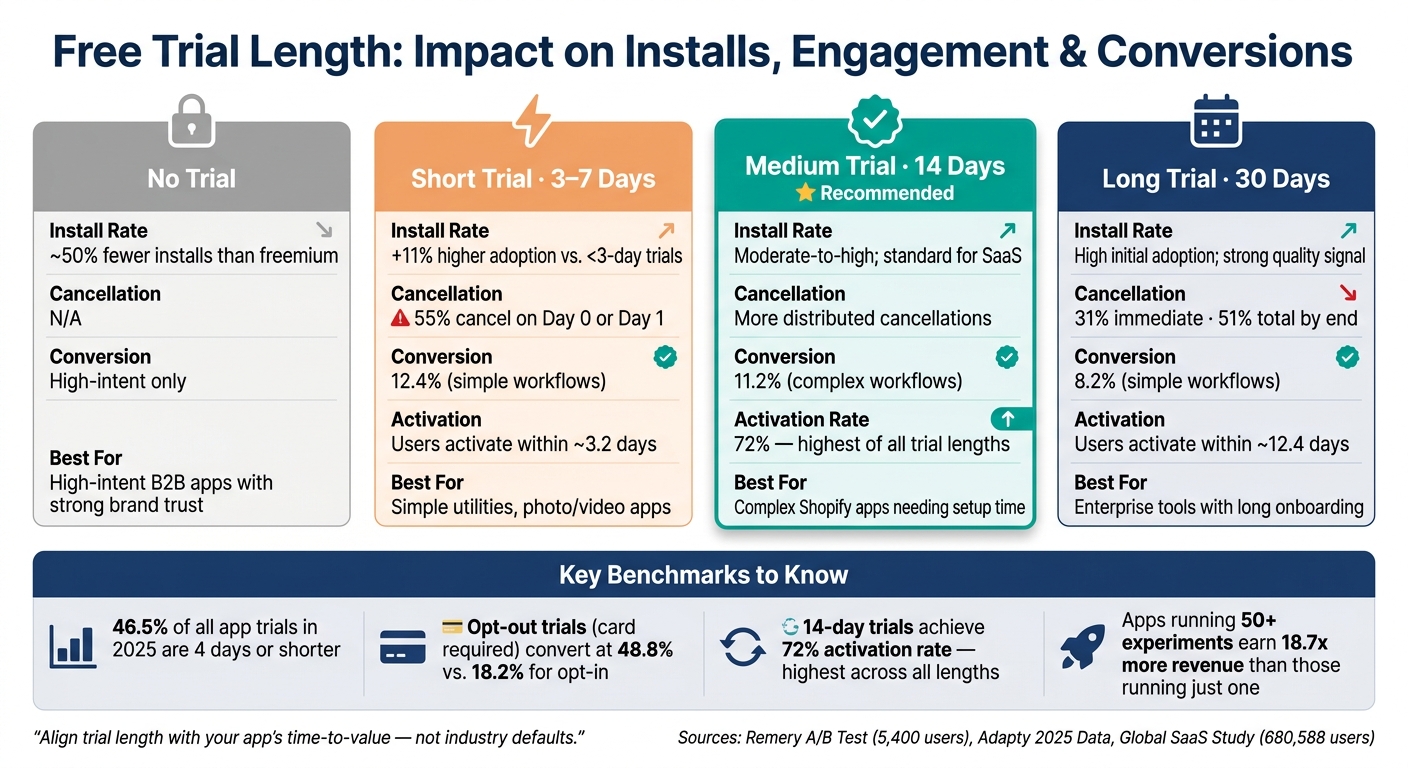
Free Trial Length Comparison: Impact on Installs, Conversions & Cancellations
How Long Should Your Free Trial Period Be
sbb-itb-ce93587
How Free Trial Length Affects Install Rates
The length of a free trial shapes how potential users perceive an app, even before they hit "Install." A longer trial can signal confidence in the app's quality, while a shorter one creates a sense of urgency. Both approaches can influence whether someone chooses to try the app. Let’s dive into the research to see how trial length impacts adoption and install behavior.
Short vs. Long Trials: What the Research Shows
Research provides valuable insights into how different trial lengths affect user behavior.
A global study conducted from July 2022 to July 2024 analyzed 680,588 new users on an image-editing SaaS platform. It compared a 3-day trial to a 7-day trial, finding that extending the trial by four days increased adoption by 11.098%.
But longer trials aren’t always a clear win. A 6-month A/B test by Remery, involving 5,400 signups split into three groups, revealed nuanced results. For simple workflows, the 7-day trial converted at 12.4%, outperforming both the 14-day (11.8%) and 30-day (8.2%) trials. However, for more complex workflows, the 14-day trial converted at 11.2%, while the 7-day trial dropped to 4.8%, as users didn’t have enough time to fully explore the app’s features.
Procrastination also plays a role with very short or very long trials. For example, 55% of users cancel 3-day trials on Day 0 or Day 1, often to avoid being charged. In contrast, 30-day trials see fewer immediate cancellations (31%), but total cancellations by the trial’s end reach 51%.
"Trial length should align with activation time, not pricing norms or industry practices." - Daphne Tideman, Growth Expert
How Trial Length Appears on App Listings
Trial length isn’t just about user experience - it starts influencing decisions at the app listing stage. App stores, like the Shopify App Store, prominently display trial durations on listing pages. This matters because 90% of users who start a trial do so on the same day they install the app. Essentially, the decision to try the app happens before the download.
A longer trial listed upfront can act as a signal of quality, showing that the developer is confident enough to give users ample time to evaluate the product. Including clear trial terms, such as "Try free for 14 days", in the app description can further reduce hesitation and make the process more transparent.
"A 7-day trial does not give you 7 days to convince someone. It gives you Day 0. Everything after that is retention work, not conversion work." - Victoria Kharlan, Adapty
Trial Length vs. Install Rate: Comparison Table
| Trial Length | Effect on Install Rate | Cancellation Trends | Best Fit |
|---|---|---|---|
| No Trial | ~50% fewer installs than freemium | N/A | High-intent B2B apps with strong brand trust |
| 3–7 Days | High initial installs; 11% higher adoption than <3-day trials | ~55% cancel on Day 0–1 | Simple utilities, photo/video apps |
| 14 Days | Moderate-to-high; standard for SaaS | More distributed cancellations | Complex Shopify apps needing setup time |
| 30 Days | High initial adoption; strong quality signal | 31% immediate, 51% total | Enterprise tools with long onboarding |
Interestingly, 46.5% of all app trials in 2025 were 4 days or shorter. This trend toward shorter trials creates an opportunity for apps offering longer trials, such as 14 days, to stand out in app listings. These dynamics highlight how trial length not only affects install rates but also sets the stage for user engagement and conversion.
How Trial Length Shapes Engagement and Conversion
Let’s dive deeper into how trial length not only impacts install rates but also plays a crucial role in driving user engagement and conversion.
Time to First Value and Activation
The length of a trial matters less than how quickly users experience value. This "aha" moment - when users realize the product’s worth - is the real game changer. A good rule of thumb is to set your trial length to roughly double your product's typical time-to-value. For example, if most users find value within two days, a 7-day trial works well. If setup or integration takes a full week, a 14-day trial gives users enough time to experience meaningful results without feeling rushed.
"Trial length is a design decision, not a default... the biggest mistake I see is treating trial length as a growth lever in isolation, rather than anchoring it to time-to-value and confidence-building." - Hannah Parvaz, Founder, Aperture
Data supports this approach. In a 6-month A/B test conducted by Remery with 5,400 users, 14-day trials achieved a 72% activation rate, outperforming 7-day trials (64%) and 30-day trials (58%). The 14-day trial struck the right balance - giving users enough time to activate without risking procrastination.
These findings highlight the importance of aligning trial length with user behavior to ensure a smooth path to activation.
User Behavior Patterns During Trials
Trial duration doesn’t just influence conversion rates - it also shapes when users activate. For instance, users on a 7-day trial typically activate within 3.2 days, while those on a 30-day trial take an average of 12.4 days. This shows how longer trials can delay engagement, potentially reducing urgency.
Behavior after app installation often determines long-term success. For products where value builds over time - like analytics tools or habit trackers - longer trials can work well. However, these need structured onboarding to encourage early engagement, rather than leaving users to explore aimlessly.
"The simplest way to frame it is this: your trial should be long enough to form a habit, but short enough to avoid being forgotten." - Daphne Tideman, Growth Consultant
In the Utilities category, trial users generate 85.1% more lifetime value (LTV) compared to direct buyers. This underscores the importance of early engagement in boosting long-term retention.
Credit Card Requirements and Trial Types
Requiring a credit card at signup can significantly shape your trial’s outcomes. This decision directly impacts both activation and conversion rates.
Opt-out trials (credit card required upfront) boast a 48.8% conversion rate, far higher than the 18.2% rate for opt-in trials (no card required). The tradeoff? Fewer users will start the trial when a credit card is required. However, those who do sign up tend to be more serious and likely to convert.
For Shopify apps, this decision acts as a filter for high-intent users. If your onboarding process is strong and your product delivers value quickly, opt-out trials often lead to better results. On the other hand, if your product requires more time to demonstrate its value, opt-in trials may attract a larger pool of users - but expect a slower path to conversion.
Measuring Trial Length Effectiveness for Shopify Apps
Understanding your trial length is one thing - figuring out if it’s actually driving results is another. Shopify app developers can rely on proven methods to measure and refine trial performance, rather than leaving it to guesswork.
Running A/B Tests on Trial Lengths
One way to evaluate your trial length is through A/B testing. Create two user segments (for example, one with a 7-day trial and another with a 14-day trial) and monitor their behavior from installation through renewal.
Run these tests for 2–4 weeks, ensuring each variant has at least 200 subscriptions to collect meaningful data. Focus on metrics that highlight long-term value, like Average Revenue Per User (ARPU) and Lifetime Value (LTV).
"The winner is whichever variant has the highest ARPU, not the highest conversion rate." - Maxim Borisik, Product Manager, Adapty
A longer trial might initially show lower conversion rates but could lead to users with better retention over 12 months, ultimately boosting LTV. By prioritizing ARPU or LTV, you gain a clearer view of what’s truly effective.
Cohort and Funnel Analysis
A/B tests can reveal which trial length performs better, but cohort analysis helps explain why. By grouping users based on their trial length and tracking their behavior over time, you can uncover trends that broader data might miss.
For instance, compare users who started with a 7-day trial against those on a 14-day trial. Look at metrics like Day 30 retention, monthly churn, and LTV. Successful Shopify apps often maintain an install-to-paid conversion rate above 15% and a monthly churn rate under 5%. If one group consistently underperforms these benchmarks, it’s likely that the trial length doesn’t align with how long your product takes to demonstrate its value.
Funnel analysis adds another layer of insight. Track where users drop off - whether it’s during onboarding, before they reach the "aha moment", or just before the trial ends. A high drop-off rate within the first 72 hours often signals that the trial isn’t showcasing value quickly enough. This is critical because 14% of merchants uninstall a Shopify app within the first 24 hours of installation. Your onboarding process during those initial hours is crucial.
Together, cohort and funnel analyses provide actionable insights and a solid base for leveraging competitive data.
Using AppJubilee to Optimize Trial Strategy
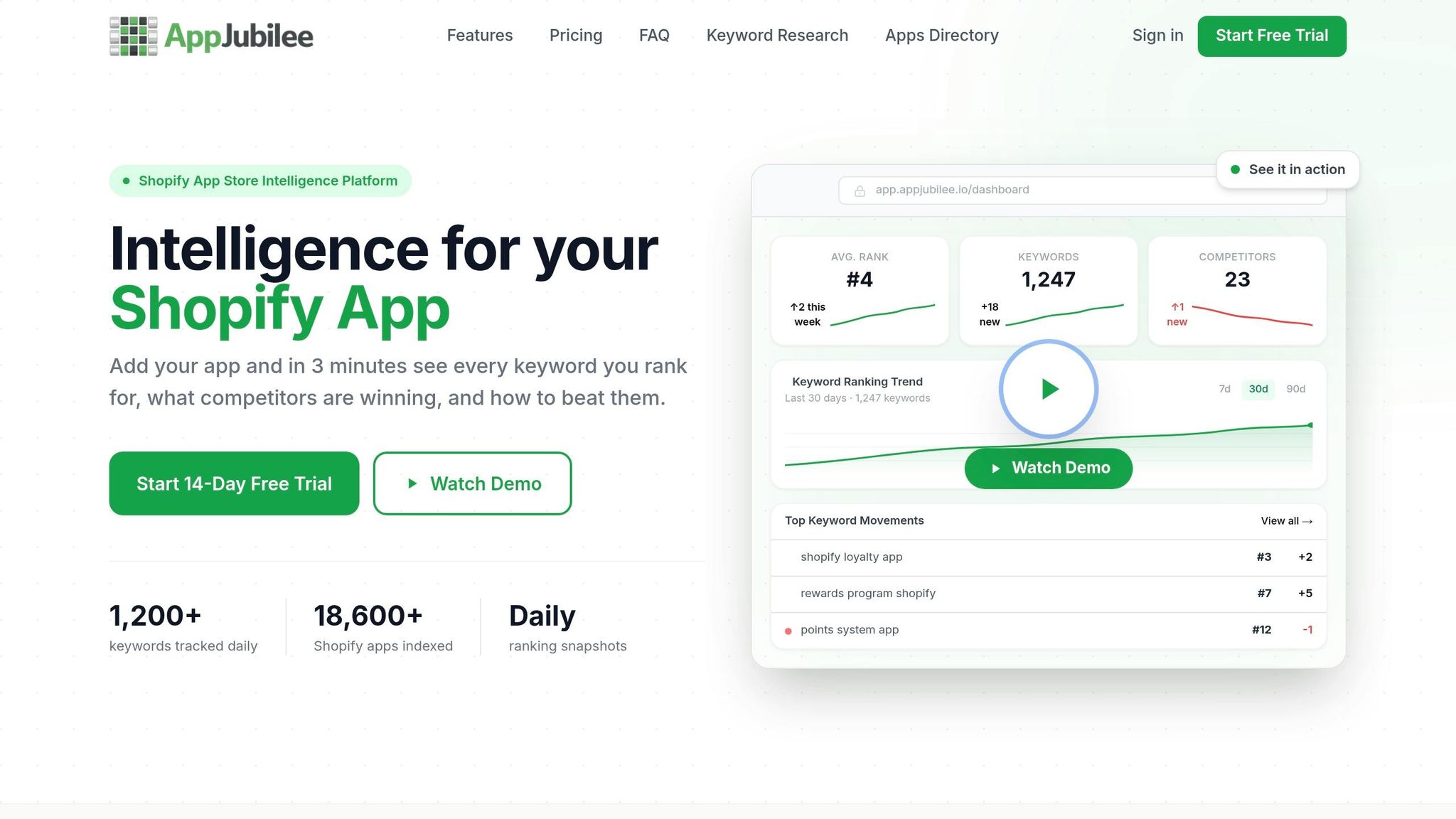
AppJubilee offers market-level insights to help you fine-tune your trial strategy. Its competitor analysis allows you to compare your trial setup with top-performing apps in your niche. For example, if leading apps in your category use 14-day trials while you’re offering just 7 days, it’s worth investigating whether a longer trial could work better. Additionally, keyword tracking can help you assess if trial-related terms (like "14-day free trial") improve your search rankings and click-through rates.
Another powerful tool in AppJubilee is review intelligence. Merchant reviews often highlight whether a trial feels too short or if users feel pressured by shorter, urgency-driven trials. These insights can guide your A/B testing decisions before committing to a full-scale experiment. Apps that frequently run structured experiments see a significant advantage - apps conducting 50+ experiments earn 18.7x more revenue than those running just one. With the right competitive insights, each experiment becomes more targeted and more likely to deliver actionable results.
Benchmarks and a Framework for Choosing Trial Lengths
Using the data above, here’s how you can refine your free trial strategy with practical benchmarks and a clear framework.
Benchmarks by App Complexity and Price Point
Not every app benefits from the same trial length. The ideal duration depends on how quickly your app delivers value and the effort required for users to experience it.
For simple, functional apps, value is often apparent right away. In these cases, a 3–7 day trial is usually enough. On the other hand, complex B2B or analytics tools - especially those requiring data collection, habit-building, or a full business cycle - often need 14–30+ days to let users see their full potential. Pricing also plays a role: higher-cost annual plans often feel riskier to users, making a longer trial (14+ days) helpful to ease concerns. Meanwhile, weekly plans can thrive with shorter trials - a 3-day trial paired with a weekly subscription is a particularly strong combination for boosting 12-month lifetime value.
"Always offer a free trial is bad advice. The data breaks it... Trials are a quality filter in some categories and a churn magnet in others." – Sven Jürgens, App Growth Consultant
For Shopify apps, which often fall into the B2B or high-complexity category, 14 days is a solid starting point. However, this is just a baseline - adjustments should be based on your app’s specific needs and user behavior.
A Framework for Selecting and Testing Trial Lengths
Choosing a trial length isn’t about guessing. A structured, data-driven process can help you find the right fit:
- Pinpoint your "Aha!" moment: Identify the key action that signals a user’s early success with your app. Set your trial length to give users enough time to reach this milestone.
- Match your app’s natural usage cycle: Make sure the trial length covers at least one complete cycle of your app’s core functionality. For instance, a 7-day trial for a monthly reporting tool might be too short for users to see meaningful results.
- Start with benchmarks and test one variable at a time: Use industry benchmarks as your starting point and run A/B tests. Change only the trial length while keeping other factors constant. Focus on LTV (lifetime value) and ARPU (average revenue per user) instead of just conversion rates when analyzing results.
- Monitor early cancellations: If users are dropping off within the first 24–48 hours, the issue may lie with your onboarding process rather than trial length. Use these signals to identify and fix onboarding gaps.
- Continuously adapt your strategy: As your app evolves and your user base grows, revisit and refine your trial strategy regularly.
Trial Length Recommendations: Summary Table
Here’s a quick overview of recommended trial lengths based on app complexity and key metrics to track:
| App Complexity | Typical Shopify App Type | Recommended Trial Length | Key Metrics to Track |
|---|---|---|---|
| Low | Simple utilities, widgets | 3–7 days | Day 0 conversion, CAC |
| Medium | Marketing tools, email apps | 7–14 days | Habit formation, D7 retention |
| High | Analytics, B2B, finance, reporting | 14–30+ days | LTV, time-to-value, delayed conversion |
Another strategy worth testing is whether to eliminate the trial altogether. In some categories, skipping the trial and focusing on direct purchases can actually improve LTV by filtering out users with low intent. While this might seem counterintuitive, it’s backed by data and could be a smart move if your trial-to-paid conversion rates are consistently underwhelming.
Conclusion
Trial durations play a crucial role in shaping how merchants interact with, evaluate, and ultimately pay for your Shopify app. Research highlights that extending a trial can boost adoption by about 11% and increase delayed conversions by over 42%. However, there’s a balancing act - short trials may lead to quick cancellations, while overly long ones risk encouraging procrastination and delaying value recognition.
The key takeaway? Align your trial length with your app’s time-to-value rather than defaulting to industry norms. Pinpoint your app’s “aha!” moment - the point where users truly see its value - and ensure the trial period is long enough for them to reach it. Testing is essential here, as apps running 50+ experiments often generate significantly higher revenue compared to those running just one.
Tools like AppJubilee can provide valuable insights by connecting trial strategies to real user data. They help you understand how factors like keyword rankings, competitor activity, and listing changes influence how merchants discover and assess your app - even before starting a trial. After all, optimizing your trial won’t matter if users aren’t finding your app in the first place.
Treat your trial strategy as a living process. Start with a baseline, focus on meaningful metrics like lifetime value (LTV) and retention (not just conversion rates), and continuously refine. The most successful developers aren’t the ones who guess the “perfect” trial length - they’re the ones who keep testing and adapting.
FAQs
How do I find my app’s time-to-value?
To figure out your app's time-to-value, focus on how long it takes for users to experience its main benefit after installation. Pay attention to user behavior and pinpoint when they complete a key action or milestone that signals satisfaction or conversion. Analytics tools can help you track the time from installation to this critical event. Streamlining the onboarding process to reduce this time can lead to better retention and higher conversion rates.
Should my trial require a credit card?
Deciding whether to ask for a credit card during a trial depends on what you're aiming to achieve. Offering longer trials without requiring a credit card can help establish trust and encourage users to engage with your product. However, this approach might also attract users who never intend to convert into paying customers. On the other hand, requiring a credit card upfront often results in better conversion rates, but it could deter some potential users from even starting the trial. The right choice comes down to understanding your target audience and aligning with your business goals.
What metrics matter most when testing trial length?
When evaluating the effectiveness of a trial period, certain metrics play a crucial role. One of the most important is the trial-to-paid conversion rate, which measures how successfully a trial converts users into paying customers. This metric provides a clear view of how well the trial communicates the product's value.
Other key indicators to watch include:
- Activation rate: Tracks how many users engage with the product meaningfully during the trial.
- Retention rate: Measures how many users stick around after their initial interaction.
- Revenue per user: Helps assess the financial impact of the trial.
Beyond these, digging into user behavior can offer valuable insights. For example, understanding how often users engage with the product and how quickly they reach their first major milestone can reveal whether the trial effectively showcases the product's value. Balancing these elements ensures the trial not only drives conversions but also fosters long-term user engagement and profitability.