
Impact Of Reviews On Shopify App Search Rankings
How review count, recency, quality and velocity shape Shopify App Store rankings, badges, AI summaries, and app growth.

Reviews are a major factor in Shopify App Store rankings. They influence where apps appear in search results, boost visibility, and drive installations. Here's what you need to know:
- Review Quantity Matters: Apps with more reviews tend to rank higher. Over 43% of top-ranking apps have more than 1,000 reviews.
- Quality Over Quantity: Recent, detailed, and trustworthy reviews carry more weight than older or generic ones. This is why avoiding fake reviews is critical for long-term ranking stability.
- Review Velocity: Apps that consistently get new reviews (e.g., 10 in a week) often outrank apps with higher total reviews but slower growth.
- "Built for Shopify" Badge Advantage: Apps with this badge have a median of 891.5 reviews, compared to 425 for those without it.
- AI Summaries: Apps with at least 100 detailed reviews and a 4.0+ rating may unlock AI-generated summaries, enhancing merchant trust.
To improve rankings:
- Request reviews at the right time (after user success).
- Use compliant, neutral language when asking for feedback.
- Address negative reviews quickly and professionally.
- Ensure a steady flow of new reviews to maintain relevance.
Reviews aren't just feedback - they're a key driver of app growth on Shopify.
How Shopify App Reviews Work: Collection, Ratings, and Display

Review Collection and Moderation Policies
Shopify allows only merchants with an active installation or those who uninstalled within the past 45 days to leave reviews. This ensures feedback comes directly from users who have firsthand experience with the app.
merchants can rate apps on a 1–5 star scale and include product review comments if they wish. Developers can make it easier for merchants to leave reviews by directing them to the review modal using #modal-show=WriteReviewModal in the URL or through the App Bridge Reviews API.
Shopify enforces strict rules around how reviews are solicited. Offering incentives like discounts, free months, or any other benefits in exchange for reviews is strictly prohibited under the Partner Program Agreement. Similarly, developers cannot explicitly request "5-star" reviews or use biased language to influence ratings. The table below outlines prohibited actions:
| Prohibited Action | Description |
|---|---|
| Incentivizing reviews | Offering discounts, free months, or other perks in exchange for feedback |
| Asking for positive reviews | Steering merchants toward favorable ratings using biased language |
| Unsolicited emails | Sending review requests that breach Shopify's communication policies |
| Compelling edits | Pressuring merchants to change or remove negative reviews |
| Fake reviews | Paying for or creating fabricated reviews |
Shopify also implements a short delay before reviews are made public. This allows their system to filter out content that violates these policies.
"We're continuously improving our systems to effectively and efficiently identify and remove fake reviews to ensure a safe, fair, and useful ecosystem for both merchants and developers." - Shopify Developer Changelog
Shopify uses an archiving system for reviews from stores on free trials, discounted plans, or inactive accounts. These archived reviews do not affect an app's overall rating. If a store transitions to a full-priced plan, archived reviews may be reinstated. However, only the 50 most recent archived reviews are displayed at the bottom of the reviews section, and they do not influence ranking calculations. This system ensures that only feedback from active, paying users shapes an app's visible rating.
How Ratings Are Calculated and Displayed
Shopify's overall star rating is calculated using a weighted system rather than a simple average. This approach prioritizes reviews that are recent, detailed, and come from trustworthy sources.
"The overall rating isn't simply an average of star ratings; it's weighted to prioritize recent, useful, and trustworthy reviews." - Shopify Help Center
Starting in April 2025, Shopify added trust signals to its rating formula. Reviews from merchants on free trials or discounted plans carry less weight or may not be published at all. This means that reviews from merchants on active, full-priced plans have a greater influence on an app's rating, even if there are fewer of them compared to reviews from trial users.
Several factors determine how reviews are weighted and prioritized:
| Factor | Impact on Rating or Display |
|---|---|
| Recency | Newer reviews are given more weight to reflect the app's current performance |
| Merchant trust | Reviews from active, full-priced merchants carry more influence |
| Usage duration | Feedback from long-term users is prioritized |
| Content quality | Detailed and meaningful reviews are ranked higher |
Even with a smaller number of reviews, quality feedback from active merchants can positively impact an app's rating.
For apps with at least 100 reviews containing written feedback and a minimum 4.0-star rating, Shopify may display an AI-generated summary of merchant experiences on the app listing page. These summaries, designed to give potential users a quick overview, can take up to 14 days to appear once eligibility is met. Reaching this milestone can also unlock additional visibility features for the app.
These mechanics provide a solid foundation for understanding how reviews can influence search rankings, which will be explored further in the next section. To see how these rankings fluctuate in real-time, you can use a Shopify App Store keyword research tool to monitor your app's performance.
sbb-itb-ce93587
Research Findings: How Reviews Influence Search Rankings
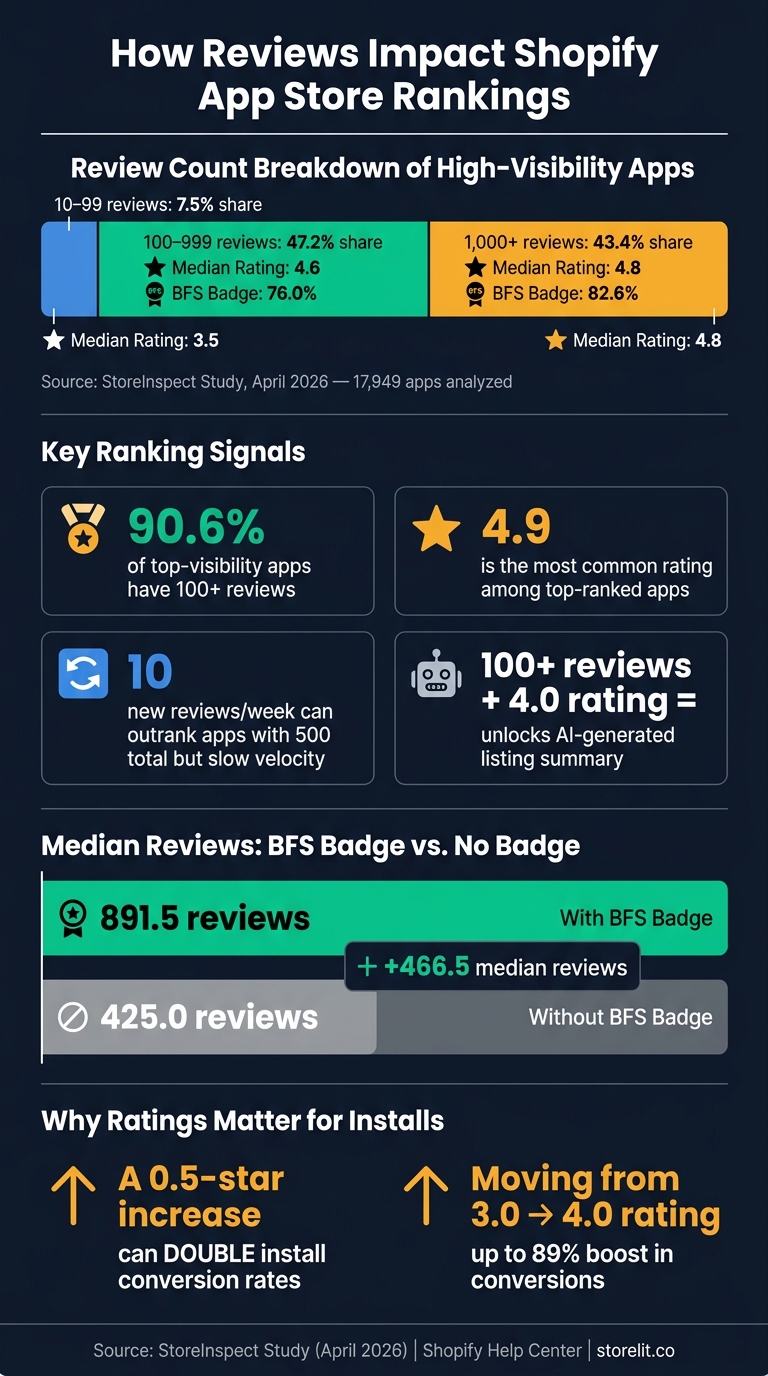
How Reviews Impact Shopify App Store Rankings: Key Stats
Review Factors That Affect Rankings
The pace at which new reviews are earned, known as review velocity, is a critical factor in ranking algorithms. Axel Cassou, founder of a Shopify app, explains:
"An app with 50 reviews that got 10 this week will often outrank an app with 500 reviews that got 2 this week. The algorithm interprets velocity as a signal of current relevance."
Another key element is rating quality. Shopify prioritizes the quality of reviews over sheer volume. Positive reviews, especially those with detailed feedback from long-standing merchants, can significantly boost an app's position in search results and category listings.
The sentiment and text content of reviews also matter. With AI tools now summarizing merchant feedback, the actual language used in reviews - beyond the star ratings - has become an additional factor influencing visibility.
These aspects provide the groundwork for the data examined in the next section.
Observed Links Between Reviews and Rankings
A StoreInspect study from April 2026, analyzing 17,949 Shopify app listings, highlights some clear trends:
| Review Count Bucket | Share of Deep Sample | Median Rating | BFS Badge Share |
|---|---|---|---|
| 10 to 99 reviews | 7.5% | 3.5 | 25.0% |
| 100 to 999 reviews | 47.2% | 4.6 | 76.0% |
| 1,000+ reviews | 43.4% | 4.8 | 82.6% |
(Source: StoreInspect Study, April 2026)
The data reveals a strong connection between review count, ratings, and the "Built for Shopify" (BFS) badge, which offers ranking advantages. Among the 53 high-visibility apps studied, 90.6% had at least 100 reviews. Top-performing apps typically maintain ratings between 4.3 and 5.0, with 4.9 being the most frequent score.
For instance, Judge.me, as of April 2026, boasted a perfect 5.0 rating across 38,206 reviews and carried the BFS badge. This combination solidifies its top-ranking position. Chris, founder of Gaintage, aptly captured the competitive edge of fresh reviews:
"Recent review quality matters more than a stale total count. A competitor with fewer reviews but fresher positive feedback can look more alive to both merchants and the App Store."
While the patterns are clear, isolating the specific impact of reviews remains a challenge.
Gaps and Limits in Current Research
Shopify's ranking algorithm lacks transparency, and while you can compare Shopify app optimization tools to gain insights, and the interaction between reviews and other ranking factors makes it difficult to pinpoint causation. Apps with higher rankings naturally gain more visibility, leading to more installs and reviews - a self-reinforcing cycle that complicates efforts to measure the direct effect of reviews. This "rich get richer" phenomenon makes it harder for newer apps to break through, even if they have strong review quality.
Additionally, survivorship bias skews the findings. Most studies focus on high-performing apps, leaving the experiences of newer or lower-ranked apps underrepresented. This gap limits the broader applicability of current research.
Review Strategies to Improve App Rankings
Getting More Positive Reviews Within Shopify's Rules
When asking for reviews, it’s essential to use neutral and compliant language. Avoid phrases like "Leave a 5-star review", and instead, go with something like, "Share your experience with a review." Stick to Shopify's guidelines - don’t offer incentives for positive feedback, as this could lead to penalties.
Liz Couto from the Shopify Partners Blog emphasizes the importance of reviews:
"Insightful reviews on apps are helpful for merchants and we want to help you get them!"
One effective approach is using a satisfaction gate. This pre-prompt asks users something like, "Are you enjoying the app?" If they say yes, they’re directed to leave a review. If not, they’re routed to a private feedback form, allowing you to address their concerns before they leave a public review.
Timing is also key. Trigger review requests after a user achieves a clear success milestone. Use Shopify’s review modal, which can be initiated via the Shopify App Bridge or by adding #modal-show=WriteReviewModal to a URL. To avoid overwhelming users, enforce a cooldown period - Shopify’s API already limits the review modal to once every 60 days and no more than three times per year per merchant.
Handling Negative Reviews to Limit Ranking Damage
Securing positive reviews is important, but how you handle negative feedback can make or break your app’s reputation. Poor reviews not only lower your overall rating but can also deter potential users. Responding quickly and professionally is crucial - aim for a 24–48 hour response time. Keep your replies factual, avoid generic apologies, and provide a clear solution to the issue.
Shopify’s developer documentation highlights the value of addressing negative feedback:
"Negative reviews can be helpful to identify issues with your app. They can also be an opportunity to showcase your willingness to problem solve and help merchants use your app effectively."
If a negative review results from a bug you’ve fixed, it’s okay to politely ask the user to consider updating their review - but never pressure or incentivize them. For reviews containing inappropriate content, personal details, or those suspected to come from competitors, you can report them to Shopify for removal.
Beyond addressing negative feedback, maintaining a steady flow of positive reviews can help offset any dips in your overall rating.
Keeping Reviews Fresh and Consistent
When it comes to Shopify’s ranking algorithm, the pace of new reviews matters more than the total number. A steady trickle of about five new reviews per week is far more impactful than a one-time surge of 100 reviews. This consistency signals ongoing relevance and engagement, which the algorithm favors over short-lived spikes.
Fresh reviews also unlock visibility perks. For example, Shopify’s AI-powered review summaries - displayed directly on your app listing - require at least 100 reviews with body text and a minimum rating of 4.0. These summaries shape how merchants perceive your app even before diving into individual reviews.
The benefits of consistent review management extend beyond rankings. According to storelit.co:
"Reviews are the closest thing the App Store has to a compounding asset. Each new review makes the next download slightly easier to earn."
Even a modest rating increase can have a huge impact. A 0.5-star jump can double install conversion rates, while moving from a 3.0 to a 4.0 rating can boost conversions by up to 89%. Keeping reviews fresh and consistent is a long-term strategy that not only improves rankings but also drives more installs.
Using AppJubilee to Track Reviews and Rankings
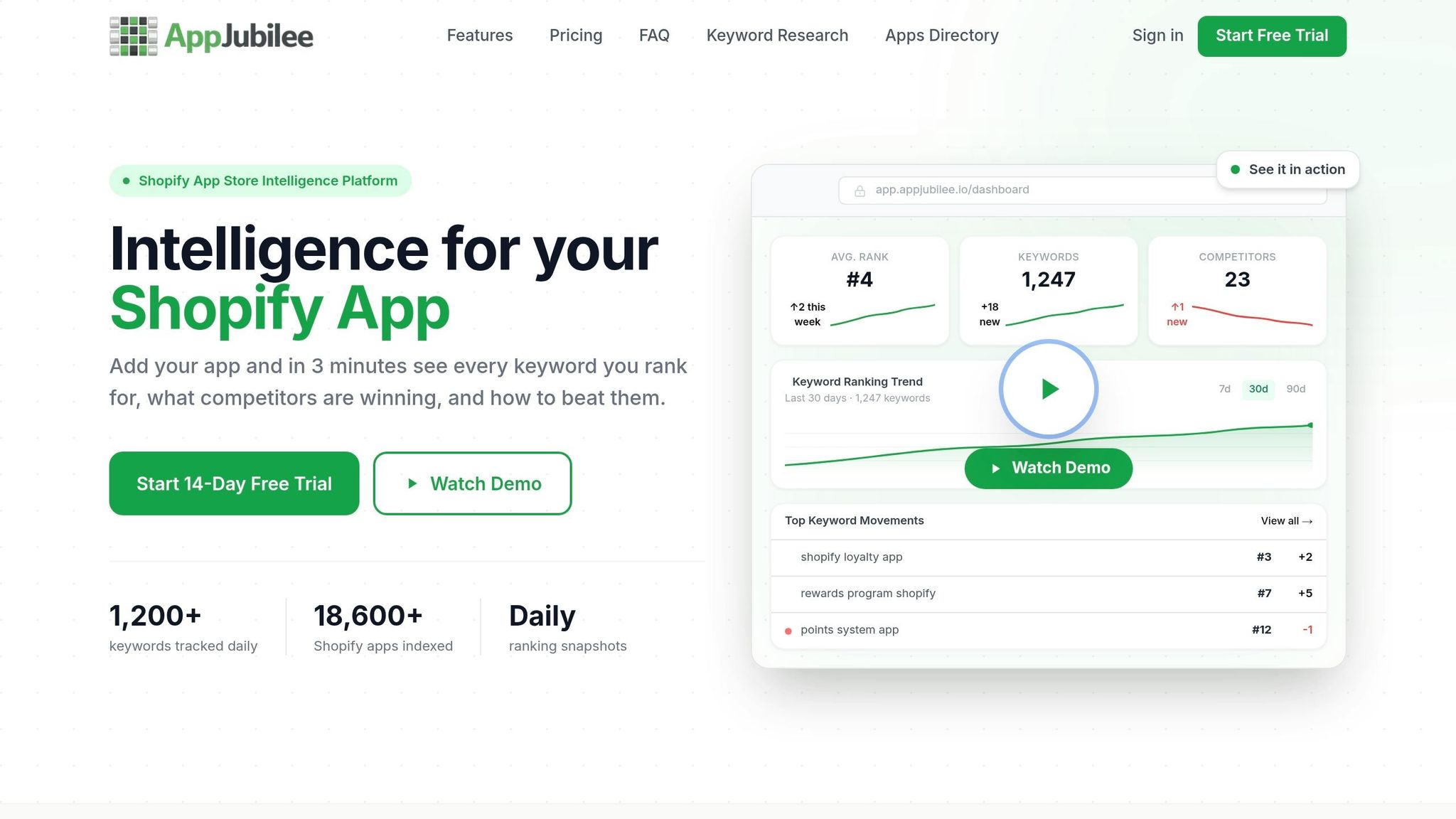
Monitoring Review Trends and Ranking Shifts
Understanding that reviews influence rankings is one thing - seeing it happen in real-time is another. AppJubilee makes this connection clear by tracking your app's keyword and category rankings daily. Within just 24 hours of a review event, you can spot visibility changes, giving you a quick feedback loop to tie review efforts directly to ranking shifts.
But AppJubilee doesn’t stop at rankings. It also monitors review velocity (how quickly new reviews are coming in), the total number of reviews, and the stability of your overall rating. For example, a sudden slowdown in review frequency might not immediately show up in your rankings, but it will appear in your velocity data, acting as an early warning system. As Chris, Founder of Gaintage, explains:
"The rank chart is the result. The install slope is often the warning." - Chris, Founder of Gaintage
This kind of detailed tracking not only helps you understand your app’s performance but also sets you up to compare it against your competitors.
Competitor Review Benchmarking
Knowing how your competitors are doing is just as important as tracking your own performance. AppJubilee’s competitor mapping feature lets you monitor how rival apps are performing in terms of reviews - not just rankings. For instance, if a competitor suddenly climbs in position, it could be due to a review surge, a new listing badge like "Built for Shopify", or a recent update to their app listing. These early signals give you the chance to act quickly and address potential ranking drops.
To get a clearer picture of your standing, compare your review count to the typical ranges seen in high-performing apps. This helps you assess your position based on real data, not just assumptions.
Measuring the Impact of Review Events on Rankings
AppJubilee takes things a step further by directly linking review events to ranking outcomes. For example, if you run a review campaign and gather 20 new reviews in a week, you can overlay this data with your daily keyword rankings to see how your positions respond.
Rankings often react to rating changes within days, and AppJubilee tracks both sentiment and volatility to identify these shifts. This level of precision allows you to plan your review campaigns more effectively, ensuring you time them when they’re most likely to lead to a ranking boost.
Conclusion: Why Reviews Are Central to Shopify App Growth
Main Research Takeaways
Reviews are more than just feedback - they directly influence your app's visibility. Shopify's documentation confirms that positive reviews help apps rank higher in search results and category pages.
Interestingly, review velocity - the rate at which new reviews come in - can sometimes outweigh the importance of having a large total review count. Additionally, apps need at least 100 detailed reviews and a rating of 4.0 or higher to enable AI-generated summaries. Apps with the Built for Shopify badge tend to perform even better, boasting a median of 891.5 reviews, compared to just 425.0 for apps without the badge.
These findings highlight actionable steps developers can take to strengthen their app’s review profile.
Steps Developers Can Take Now
To improve your app's ranking and reputation, consider these strategies:
- Request reviews at the right moments: Timing is everything. Ask merchants for reviews after they've successfully completed core tasks or after resolving support issues. Satisfied users are the most likely to leave thoughtful, positive feedback.
- Stick to neutral language: When requesting reviews, avoid asking specifically for "positive" reviews or offering incentives. Both practices violate Shopify's guidelines and could harm your credibility.
- Engage with every review: Respond to all reviews - good or bad. This shows potential users that you’re attentive and proactive. For negative reviews, resolving issues and politely requesting an updated review can turn things around.
- Keep reviews coming: Regularly collect fresh reviews to stay competitive and maintain your app's relevance in rankings.
A consistent, well-thought-out review strategy can make a significant difference in your app's growth trajectory.
FAQs
How many reviews do I need to rank on Shopify?
Having a specific number of reviews isn’t a strict requirement to rank on Shopify. That said, aiming for at least 100 reviews with a rating of 4.0 or higher can improve your visibility. Even more crucial than the total number is maintaining a steady stream of recent reviews, as this ongoing activity plays a bigger role in rankings.
Do recent reviews matter more than older reviews?
Yes, recent reviews play a bigger role because Shopify's ranking system prioritizes recency, usefulness, and trustworthiness. Newer, well-written feedback has a greater impact on search rankings and app visibility than older reviews.
Why aren’t some reviews counting toward my rating?
Some reviews won't impact your overall rating because they may have been removed for failing to meet trust and quality standards. This can include reviews that are fake, spammy, incentivized, or violate guidelines. Also, archived reviews are not included in your rating or total review count.