
Do Keywords in Reviews Affect App Rankings?
How review keywords influence app rankings across Shopify, Google Play, and Apple App Store, with practical tips for developers.
Keywords in reviews can influence app rankings, but the impact varies by platform. On the Shopify App Store, detailed and recent reviews help algorithms better understand an app’s relevance to search queries. Reviews that mention specific features or benefits can improve visibility and trust, boosting rankings. Shopify also uses AI to analyze review content for summaries, which further enhances discoverability. For Google Play, review text and even developer replies are indexed directly, affecting search rankings. However, on the Apple App Store, reviews mainly influence user trust and conversion rates, with minimal impact on keyword rankings.
Key takeaways:
- Shopify ranks apps higher when reviews highlight relevant features and benefits.
- Google Play indexes review text and replies, directly affecting app rankings.
- Apple App Store focuses on review sentiment rather than keywords for rankings.
- Encouraging detailed reviews and responding with relevant terms can improve visibility.
Understanding how reviews influence rankings allows developers to optimize their apps for better discoverability and user engagement.
App Rankings and Review Keywords Explained
What Are App Rankings?
App rankings decide where your app shows up in Shopify App Store search results and category pages. The higher your app ranks, the more visibility it gets, which can lead to more installs.
While Shopify doesn’t publicly share its ranking formula, several factors are known to play a role, including query relevance, listing quality, app performance, merchant trust, and recent demand. One key factor is install velocity - a measure of how quickly your app gains new installs.
Shopify also uses a weighted rating system rather than a simple average. This system values reviews that are recent, helpful, and credible more than older ones. For example, apps with the "Built for Shopify" badge typically perform better, with a median of 891.5 reviews compared to 425.0 for apps without the badge, and a median rating of 4.8 vs. 4.5.
"Positive reviews make your app appear higher in Shopify App Store search results and category pages." - Shopify Developer Documentation
Why Keywords in Reviews May Matter
Reviews influence more than just star ratings. The language used in reviews can help Shopify’s algorithm better understand and categorize your app. These reviews act as relevance signals, guiding the system to determine which search queries your app should appear for.
This is particularly evident with Shopify's AI-powered review summaries. To qualify for these summaries, an app needs at least 100 text-based reviews and a minimum 4.0 rating. The AI analyzes the content of reviews, extracting key features and benefits. Reviews that mention specific functionalities, use cases, or outcomes not only help merchants make decisions but also improve how the algorithm perceives your app. This boosts relevance, trustworthiness, and ultimately, rankings.
sbb-itb-ce93587
What the Research and Evidence Show
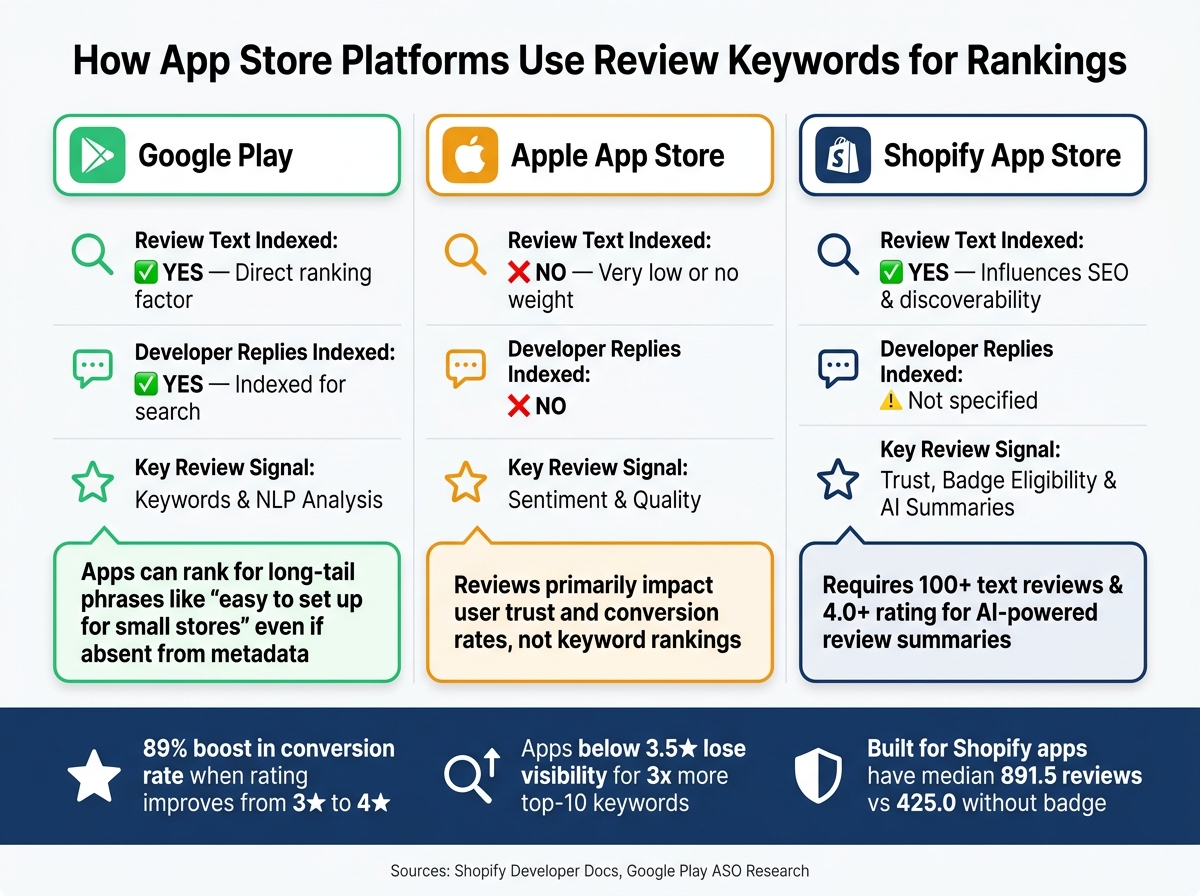
How App Store Platforms Use Review Keywords for Rankings
Insights from Mobile App Stores
On Google Play, review text plays a direct role in app rankings. If users frequently mention terms like "budget tracker" or "video editor" in their reviews, Google Play can rank your app for those keywords - even if they're missing from the app's metadata. Interestingly, Google Play also indexes developer replies. This means that responses to reviews, when enriched with relevant keywords, can directly influence search rankings.
"Google Play indexes your developer replies too, not just the reviews themselves. Add relevant keywords to your replies and they get picked up in search. It's a free ASO lever hiding inside your support workflow." - Viktor Seraleev, Founder, Seraleev Apps
On the other hand, the Apple App Store operates differently. Apple doesn’t index review text for keyword rankings like Google does. Instead, reviews primarily serve as indicators of sentiment and quality, impacting user trust and conversion rates. While some experts speculate that frequent mentions of specific features might have a minor, indirect influence, this remains unverified.
Parallels with Local SEO Research
Google Play’s ranking algorithm shares similarities with Google’s web search engine, particularly in its use of Natural Language Processing (NLP). This allows the platform to interpret user-generated content, such as reviews, much like how Google processes local business reviews. Apps can rank for "intent clusters", which are long-tail phrases naturally written by users, like "easy to set up for small stores." These phrases might not appear in the app’s official metadata but can still boost rankings. This mirrors how local businesses gain visibility through organic language in Google reviews.
Comparing Direct and Correlational Evidence
The impact of reviews varies significantly across platforms. Here's a summary of how reviews and replies affect app rankings:
| Platform | Review Text Indexed | Developer Replies Indexed | Key Review Signal |
|---|---|---|---|
| Google Play | Yes - direct ranking factor | Yes | Keywords & NLP analysis |
| Apple App Store | No, or very low weight | No | Sentiment & quality |
| Shopify App Store | Yes - influences SEO | Not specified | Trust & badge eligibility |
For Shopify, reviews also contribute to app visibility, with keyword usage and review quality playing key roles. Ratings, in particular, have a strong correlation with visibility. Apps with ratings below 3.5 stars lose visibility for three times as many top-10 keywords compared to apps with higher ratings. Additionally, moving from a 3-star to a 4-star rating can boost conversion rates by up to 89%. While each platform approaches reviews differently, one thing is clear: user reviews consistently shape app rankings, making the content of reviews - and how users describe their experiences - essential.
How Review Keywords Could Affect Rankings
Direct Effects of Review Keywords
On the Shopify App Store, Shopify clearly states that positive reviews help apps rank higher in search results and category pages. The algorithm places value on reviews that provide detailed insights into an app’s workflows, features, or problem-solving capabilities. When merchants write reviews that specifically highlight how an app benefits their business, these details can significantly influence app rankings.
Shopify's AI-powered summaries pull directly from the text of reviews. The exact words merchants use in their feedback can shape what these summaries emphasize, which in turn can impact click-through rates and other ranking signals. These direct effects create a foundation for broader impacts on user engagement.
Indirect Effects on Rankings
Beyond the direct indexing of review content, keywords in reviews also influence user behavior. When reviews use language that aligns with what merchants are actively searching for, they can spark interest, drive installs, and signal relevance to Shopify's algorithm. Additionally, the trajectory of an app’s ratings can have a major impact. Apps with improving ratings often outperform those with stagnant scores. For instance, moving from a 3-star to a 4-star rating can boost conversion rates by as much as 89%. As Rohit Kaul, VP of Marketing at Blume Ventures, explains:
"Improving your app's rating from 3 to 4 can boost your install campaign's conversion rate by 89%. A high rating signals trust to new users who land on your app store page, dramatically increasing the odds of them tapping the install button."
Limitations and Open Questions
While Shopify provides some guidance, the exact ranking formula remains undisclosed. There is no publicly available breakdown showing how much review keyword density contributes to rankings compared to other factors like recency or trustworthiness, though you can compare Shopify app store optimization tools to see how different platforms track these signals. This leaves developers relying on Shopify’s documented signals rather than a clear understanding of the mechanics.
Unlike Google Play, Shopify places greater emphasis on recency and trust over sheer keyword frequency. For example, while Google Play directly indexes review text and developer replies, Shopify's system archives reviews from merchants who are no longer on active, full-priced Shopify plans. These archived reviews are excluded from rating calculations, a nuance that doesn’t have a direct parallel on Google Play.
What This Means for Shopify App Developers
As mentioned earlier, the language used in reviews significantly impacts app rankings. Here's how Shopify app developers can take advantage of this information.
Tracking Review Keywords and Trends
Start by identifying recurring words and phrases in your top reviews. For instance, if users frequently mention "automatic inventory sync" or analytics or "one-click upsell", those terms could be influencing how Shopify's algorithm categorizes your app.
Pay attention to how often these keywords appear and how recent the reviews are. Shopify places more weight on recent, detailed, and trustworthy reviews rather than relying solely on a lifetime average rating. This means maintaining a steady stream of fresh feedback is more valuable than simply amassing a large number of older reviews.
It’s also worth analyzing competitor reviews. Look for patterns where merchants highlight missing features in rival apps. These gaps could turn into valuable search terms, giving you an opportunity to rank for searches your competitors might not be addressing.
To make this process more efficient, consider using tools designed to transform these insights into actionable strategies.
Using AppJubilee for Review Intelligence
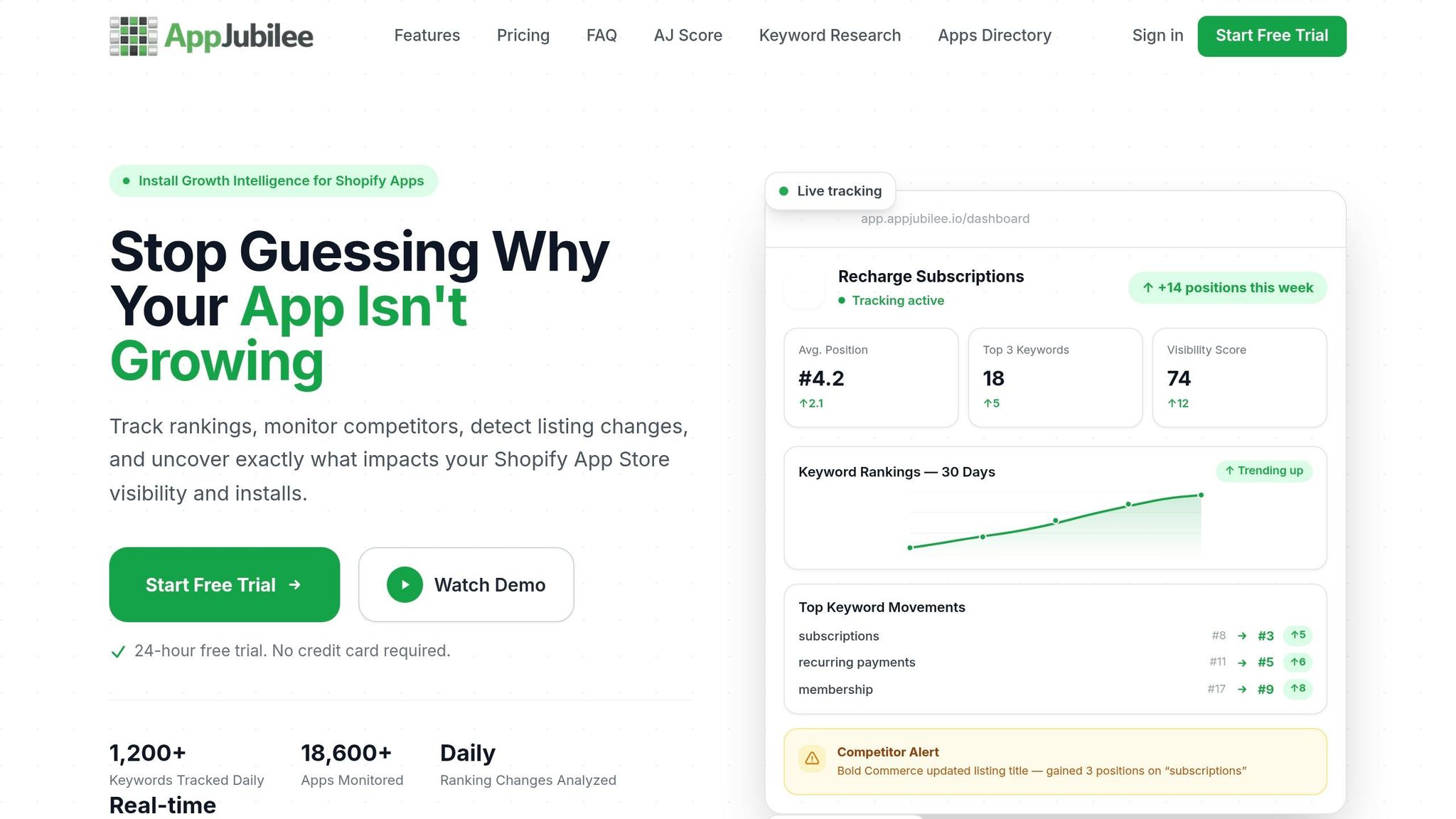
Manually tracking keywords in reviews can be tedious and prone to mistakes. That’s where AppJubilee comes in. Its Review Tracking & Impact Analysis feature connects changes in review content directly to shifts in keyword rankings, removing the guesswork from improving your app’s visibility.
AppJubilee also keeps an eye on competitor activity with its Competitor App Watch feature. By comparing how your reviews and rankings stack up against rivals - and using daily keyword tracking and ranking updates - you can test whether tweaks in review language are boosting your rankings. This focused method ensures that your review management efforts directly contribute to improving your app’s performance.
Best Practices for Using Review Keywords
Building on the influence of review keywords, here are some practical tips to make the most of this insight.
Encouraging Detailed, Keyword-Rich Reviews
The language in reviews can significantly affect app rankings, so it's essential to encourage merchants to leave detailed feedback. For instance, instead of a generic request, ask specific questions like, "What did you find most helpful about our inventory sync feature?" This naturally prompts them to use key terms that boost search visibility.
Timing is everything - request reviews right after a positive merchant experience, such as completing their first sale or finishing setup. This approach increases the likelihood of receiving timely and relevant feedback.
Keep in mind Shopify's strict guidelines: use neutral language and avoid offering incentives like discounts or free services in exchange for reviews. Violating these rules can lead to penalties, including app demotion or removal from the App Store. To maximize responses, consider using Shopify's native Reviews API to display a review prompt directly within the admin dashboard. This strategy has been shown to generate 3–5 times more responses.
Responding to Reviews with Purpose
Responding to reviews isn’t just good customer service - it also plays a role in your app's ranking. Replies that include relevant keywords can improve search visibility, so reflect key phrases from the review in your response. For example, if a merchant mentions "automated order tagging", include that term naturally in your reply. Avoid overloading responses with keywords, as this can come across as inauthentic to both users and algorithms. Aim to respond within 24 hours, as timely replies can make a big difference. Merchants who receive helpful responses are 33% more likely to update a low star rating.
Running Before-and-After Analyses
To measure the impact of these strategies, take a systematic approach. Start by monitoring your target keywords - note your current rankings and observe any changes over the next 2–4 weeks after reviews begin mentioning those terms.
Additionally, perform regular audits of your app's metadata every 4–6 weeks, updating it based on the latest review language. Combine this with weekly keyword position tracking to identify clear trends. Tools like AppJubilee's Review Tracking & Impact Analysis feature can simplify this process by linking changes in review content directly to shifts in keyword rankings, so you can see exactly how your efforts are paying off.
Conclusion: What Review Keywords Mean for App Rankings
Review keywords play a crucial role in app rankings, influencing them both directly and indirectly. Shopify openly states that reviews affect search visibility and category placement, reinforcing their importance. As algorithms evolve to better understand semantics, the language merchants use in their feedback is becoming a stronger signal - not just a measure of trust.
This shift is part of a larger trend, as highlighted by Stormy AI:
"The algorithm is no longer just a librarian; it's a semantic analyst. It prioritizes what users say you are over what you claim to be."
With this in mind, the focus is moving away from metadata and toward the language real users use in their reviews. Merchant feedback is now a critical factor in determining an app’s ranking.
Reviews should be seen as an active part of your ASO strategy, not just a byproduct of customer service. Apps with lower ratings face reduced visibility, showing that review sentiment directly impacts discoverability - it’s far more than a vanity metric. Given these stakes, having the right tools to act on this data is essential.
Tracking reviews manually can be overwhelming. Tools like AppJubilee make it easier by connecting shifts in review language to changes in keyword rankings, offering clear insights into what drives results. This data-driven approach highlights the growing importance of review language in App Store optimization.
FAQs
How many reviews do I need before review keywords start to matter?
Once your app achieves a rating between 3.5 and 4 stars, reviews can start influencing its ranking. But here's the kicker: apps with ratings above 4.0 tend to gain even more visibility in the app store.
There's another important factor to consider - keywords in reviews. When users include relevant keywords in their feedback, it can boost your app's keyword relevance and improve its ranking performance. Essentially, good reviews do more than just build credibility; they can also play a role in how easily your app is discovered.
How can I ask for keyword-rich reviews without breaking Shopify’s rules?
To gather keyword-rich reviews while staying within Shopify’s guidelines, focus on using neutral and compliant language. Avoid explicitly asking for positive reviews or offering any form of incentive. Instead, time your requests thoughtfully - like right after assisting a customer or resolving an issue. Use open-ended questions such as, "What feature do you find most useful?" or "How has our app improved your experience?" This method allows users to naturally include relevant keywords in their feedback while ensuring compliance with Shopify's rules.
How do I measure whether review keywords actually improved my rankings?
To see if review keywords are boosting your rankings, keep an eye on your app's keyword positions over time. Consistently monitor how your target keywords are performing and watch for upward trends after you've optimized review content or responded to user feedback. Over a period of 4-6 weeks, compare ranking shifts with review activity - like a rise in positive reviews that include specific keywords - to spot any potential connection.