
Organic vs. Paid: Growing Shopify App Installs in 2026
Use paid ads to get early installs and data, then focus on organic ASO, reviews, and retention to cut CAC over time.
If I had to sum it up in one line: use paid to get data and early installs, then lean on organic to lower CAC over time.
With 17,591 Shopify apps in the App Store as of April 2026 and 65% of installs coming from App Store search , which you can monitor using Shopify app keyword rankings tools, I’d treat organic search as the base channel. But I wouldn’t ignore paid. Shopify Search Ads can bring traffic fast, especially in the first 4–8 weeks after launch or in crowded categories.
Here’s the short version:
- Organic wins on durability. It takes about 4 to 12 weeks to move rankings, but results can keep working after the work is done.
- Paid wins on speed. Installs can start within days, but spend stops and traffic stops.
- Listing quality decides both. If your page doesn’t convert, ads just burn budget and weak retention can hurt rank.
- Reviews matter a lot. A 4.5+ star rating, steady review flow, and fast developer replies help both ranking and conversion.
- Retention is the filter. Paid traffic only helps if those users stick around.
- Best mix by stage and tool: new apps test with paid, growing apps tighten terms and reviews, scaled apps let organic do most of the work.
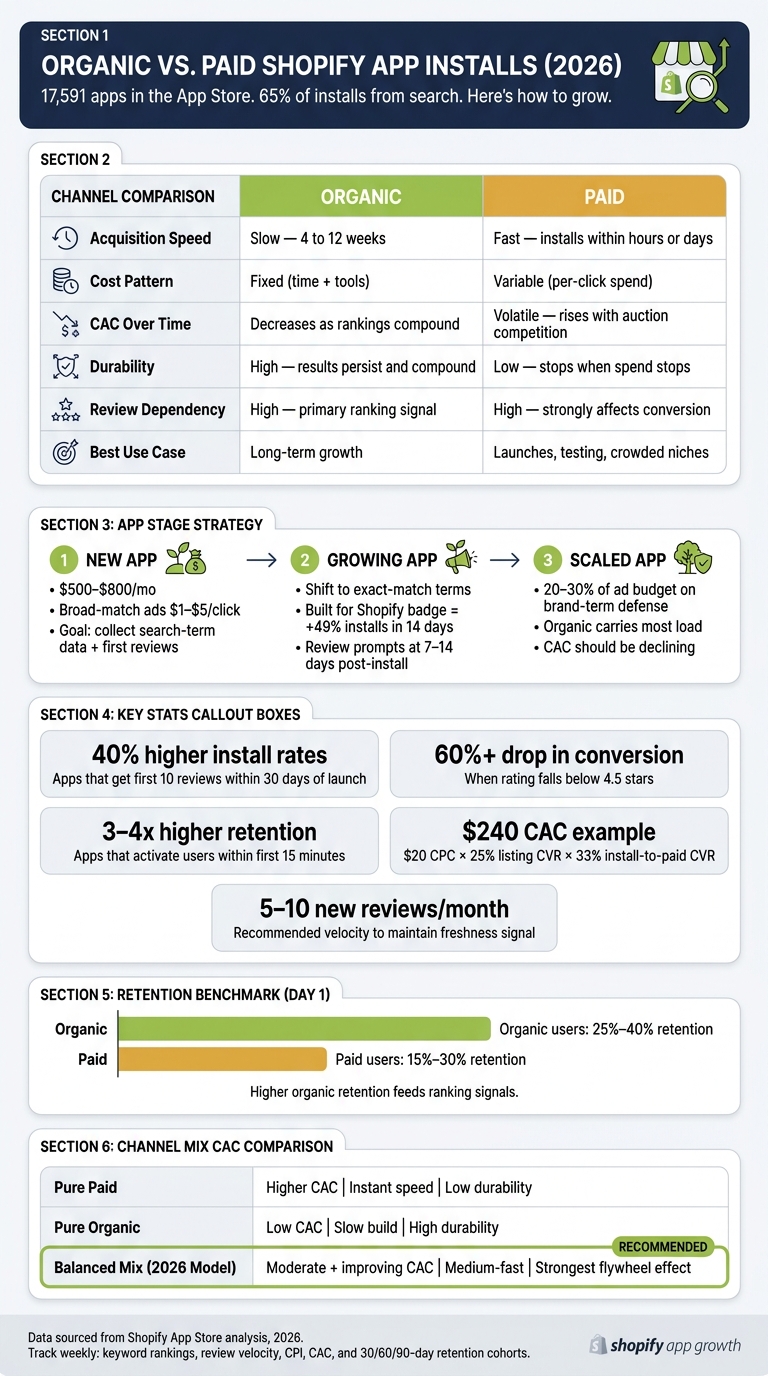
Organic vs. Paid Shopify App Installs: Channel Comparison by Stage (2026)
Shopify App Growth: $0 to $50k MRR Step by Step - Mat De Sousa | Techtonic 2025

sbb-itb-ce93587
Quick Comparison
| Factor | Organic | Paid |
|---|---|---|
| Speed | Slow | Fast |
| Cost pattern | Time + fixed work | Variable ad spend |
| CAC over time | Often drops | Can swing a lot |
| Lasting impact | High | Low once spend stops |
| Review dependency | High | High |
| Best use case | Long-term growth | Launches, testing, crowded niches |
I’d make the channel choice based on a few numbers first: install conversion rate, review count, rating, 30-day retention, CPI, and CAC. If those are weak, the issue usually isn’t traffic. It’s the listing, onboarding, or product fit.
That’s the core idea: paid gets attention, organic keeps growth going, and the listing connects the two.
Organic vs. Paid Installs: What Each Channel Actually Delivers
The tradeoff is simple: speed now vs. value that builds over time.
| Factor | Organic | Paid |
|---|---|---|
| Acquisition Speed | Slow - 4 to 12 weeks for meaningful ranking movement | Immediate - installs can start within hours or days |
| Upfront Cost | Fixed (tools, content, time) | Variable (per-click spend, daily budget) |
| CAC Stability | Decreases over time as rankings compound | Volatile - costs rise with auction competition |
| Review Dependency | High - reviews are a primary ranking signal | High - reviews strongly affect conversion |
| Durability | High - results persist and compound | Low - installs stop when spend stops |
| Effect on Long-Term Ranking | Direct - metadata, category fit, and behavior signals matter | Indirect - retained paid installs can feed organic rank |
This split helps you decide which channel should lead at a given stage.
Organic Installs: Slower to Start, Stronger Over Time
Organic growth takes patience. The algorithm looks at keyword alignment, clear category fit, and post-install behavior such as retention and active usage. Those signals build on each other, but they don't show up overnight.
New apps run into a classic catch-22: you need installs to rank, but you need rank to get installs. That's why early review momentum matters so much. Apps that get their first 10 reviews within 30 days of launch see 40% higher install rates in the two months that follow. Without that early trust signal, it gets much harder to gain momentum.
Keyword alignment still plays a big role, even as brand-led naming becomes more common. In plain English, this helps determine whether your app can win visibility on its own or if it needs advertising support to get moving.
Paid Installs: Faster Traffic, but Dependent on Listing Quality
Paid installs can bring traffic fast. But ads only buy the click. Your listing still has to turn that click into an install.
If the listing is weak, budget disappears fast. A poor listing can cut conversion by more than half, which means a big chunk of spend goes to waste. And there's another catch: if those paid users churn fast, the algorithm can read that as weak fit. When that happens, your organic rank can drop.
So the main lever isn't just spend. It's listing quality.
How Reviews and Ratings Affect Both Channels
Reviews influence both rank and conversion, and most merchants look at them before they install. Apps with an average rating below 4.5 stars see conversion rates drop by more than 60%, whether the traffic came from search or a paid ad.
Fresh reviews carry more weight than old ones. An app with fewer recent, high-quality reviews can outrank an older app with thousands of stale reviews. A practical goal is 5 to 10 new reviews per month to keep that freshness signal active. Developer response time also affects rank.
These signals don't hit the same way at every stage. Their role shifts depending on whether your app is launching, picking up traction, or scaling.
When to Choose Organic and When to Choose Paid
The right channel depends on where your app is right now.
When Organic Works Best
Organic is usually the better long-term bet once your listing has real momentum. If it converts at 15%–20% or higher, keeps a 4.5+ star rating, and brings in 5–10 new reviews per month, organic can build on itself over time. As rankings improve, blended CAC tends to drop.
Organic users also tend to stick around more. Day 1 retention often lands at 25%–40% for organic, versus 15%–30% for paid users.
When Paid Works Best
Paid makes sense when you need volume before organic has time to build. It works best when speed matters more than efficiency. The clearest cases are the first 4–8 weeks after launch, seasonal campaigns, and crowded categories where established organic players are tough to move past.
Paid gets the click. The listing still has to win the install.
Before you spend on paid campaigns, make sure the listing is in decent shape:
- 20–30 genuine reviews
- 4.5+ average rating
- 30-day retention above 50%
If those signals aren't there, paid spend often does one thing: it scales weak performance instead of building growth that lasts.
Where Each Channel Breaks Down
Organic slows down when review volume is too low to compete in rankings.
Paid starts to fail when the users it brings in don't stay. Shopify's algorithm can read that churn as a negative signal, and that can pull down organic rank. A simple warning sign is when paid installs stop creating enough organic lift to make the spend worth it.
At that point, the fix is usually not "spend more." It's to improve the listing and retention first, using the same levers that shape both channels: conversion, reviews, retention, and CAC.
Those breaking points shape how you divide organic and paid spend at each stage.
How to Balance Organic and Paid for Steady Install Growth
Paid and organic do different jobs, and that’s the whole point. Use paid to learn. Use organic to build momentum over time.
Paid campaigns show you which search terms lead to installs. Then you can use those terms to tighten up your app title, subtitle, and description. Paid installs also give you more chances to earn reviews, which matters because Shopify puts a lot of weight on recent review activity. But there’s a catch: this only works if your listing can convert the traffic you’re paying for.
Channel Mix by App Stage: New, Growing, and Scaled
Your app stage should shape both your budget and your focus.
For new apps, the goal is learning. Start with low-bid broad-match ads to test intent and collect search-term data. A monthly budget of $500–$800 is often enough to build an early baseline of installs and reviews, with broad-match bids around $1–$5 per click. At this stage, don’t obsess over efficiency yet. You’re trying to find out what people search for, what they click, and what gets them to install. Once conversion starts to improve, you can move from research mode into efficiency mode.
For growing apps, it makes sense to put more budget into exact-match terms that already show good conversion and user retention. This is also the point where Built for Shopify can make a big difference. It has been linked to an average 49% lift in new installs within 14 days. Review generation should also get more deliberate. Send prompts 7–14 days after install, and try to time them after a clear win, like a first sale or the first email sent.
For scaled apps, paid should help protect what you’ve already built. Use it to defend brand terms and other high-intent searches. Putting 20%–30% of ad budget into brand-term bidding can help protect your traffic and hold visibility on high-intent queries. In packed categories, defend those high-intent terms first. At this point, organic should carry most of the load, while paid helps protect the listing and smooth out growth.
What to Fix Before Increasing Spend
More traffic won’t help much if the listing doesn’t convert.
Before you spend more, fix the basics:
- Put the brand name first in the app title, while staying within the 30-character limit
- Use the subtitle for secondary keywords and clear outcome-driven messaging
- Show real app interface screenshots with text overlays that point to user benefits
Then look at onboarding. This part is easy to overlook, but it hits retention hard. Apps that activate users in the first 15 minutes after install see 3–4x higher retention. If users land, install, and then stall out, your paid spend starts leaking almost right away.
Budget Tradeoffs and CAC Expectations
Once the listing is in good shape, the next issue is simple: how much CAC can you live with?
Paid acquisition in the Shopify App Store can get expensive fast. A $20 click, a 25% listing conversion rate, and a 33% install-to-paid conversion works out to a CAC of about $240. In tough categories like email marketing or loyalty, CAC can climb to $30–$100+.
| Channel Mix | CAC | Speed | Durability | Ranking Benefit |
|---|---|---|---|---|
| Pure Paid | Higher, varies by niche | Instant | Low - stops when spend stops | Strong only when retention is healthy |
| Pure Organic | Low, mostly time and content investment | Slow - builds over time | High - compounds | Self-reinforcing through retention and reviews |
| Balanced (2026 Model) | Moderate and improves over time | Medium-fast | High - paid feeds organic | Strongest flywheel effect |
If CAC starts climbing, that often means competing listings are getting tougher. Before you put in more budget, compare your listing against theirs. Look at screenshots, review velocity, keyword use, and positioning. Then track whether your mix is actually pushing CAC down and helping rank move up.
Measurement, Competitor Tracking, and Next Steps
What to Track Every Week
Once your mix is live, weekly tracking tells you if it's building momentum or quietly leaking performance. Base channel calls on weekly data, not instinct. The main buckets to watch are search visibility, conversion, reputation, economics, and post-install quality.
| Weekly Tracking Category | Specific Metrics to Monitor |
|---|---|
| Search visibility | Keyword rankings, Built for Shopify status |
| Conversion | Listing click-through rate (CTR), install conversion rate, screenshot/tagline impact |
| Reputation | Review velocity (last 7/30/90 days), average rating, sentiment trends |
| Economics | Cost per install (CPI), customer acquisition cost (CAC), payback period |
| Post-install quality | Activation rate (first 72 hours), same-day uninstalls, 30/60/90-day retention cohorts |
These signals help you decide whether to spend more, trim wasted clicks, or fix the listing before doing anything else.
A healthy search CTR usually lands between 8% and 15%. If you're below 5%, that's often a sign of a weak icon, title, or low rating. For high-intent keywords, install conversion rates should usually fall between 5% and 12%. If you're under 1%, the issue is often poor intent match.
When clicks and installs look good but active use drops off, the problem usually isn't discovery. It's onboarding. The clearest long-term signal of organic health is how many merchants stick around after installing, compared with how many install in the first place.
If a paid campaign drives installs and those merchants uninstall within hours, pause it fast. High same-day uninstall rates can hurt organic rankings because Shopify puts heavy weight on post-install behavior.
Shopify Search Ads run on a first-price auction. That means your bid is the exact amount you pay per click, so weekly bid checks matter. On the paid side, review the search-term report every week. Move strong terms into Exact Match and cut clicks that don't fit.
One more thing: respond to every review within 48 hours. Developer responsiveness is a documented ranking signal.
How to Compare Your Listing Against Competing Apps
Use that same weekly data to figure out why competitors are outranking you.
Start with ranking snapshots. Track where your app and top competing apps appear for the same keywords over time. When a competitor jumps up, look at what changed. Did they update screenshots, tighten their description, or change pricing? Listing refreshes can help. Updating assets every 30 to 60 days may support ranking by signaling active development.
Shopify doesn't give you a search-query report, so you have to piece things together. Look at App Ads recommended keywords, search-bar autocomplete, analytics terms that drive installs for competing apps, and the words merchants use in reviews. That gives you a clearer picture of demand.
Review velocity matters more than total review count. An app that picks up 50 reviews in 30 days can outrank an app sitting on 500 older reviews because the algorithm puts heavy weight on a 90-day recency window.
If you're checking keyword gaps, don't just copy competitor titles word for word. The app name carries the most ranking weight, then the subtitle, then the first 100 characters of the description. Research also shows that a median of only 3 out of 8 keywords in a competitor's title and subtitle drive 80% of installs. The rest usually plays a smaller role.
Also check whether top competitors have Built for Shopify. If you don't have it and they do, that alone may explain part of the ranking gap.
Conclusion: Choose the Mix That Fits Your App Stage
The right mix is the one your weekly data shows is improving rank, retention, and CAC.
Organic takes longer, but it builds over time. Paid moves faster, but it only works when your listing can convert the traffic you're buying and the merchants who install don't disappear right away.
The strongest 2026 approach isn't picking one side. It's using both in stages. Use paid early to gather search-term data and test which terms are worth chasing. Then let organic do more of the heavy lifting as your listing, retention, and review velocity improve.
The apps that keep growing in 2026 are the ones that treat the listing like a living asset, watch keyword and review signals every week, and shift spend toward the channels and terms that bring in merchants who stay.
FAQs
How much should I spend on paid installs first?
Start simple. Focus on Shopify App Store listing optimization first, and use paid installs mostly to validate ideas and collect data.
If installs aren’t turning into active merchants yet, ads are the costliest way to figure out what works. Early on, keep tests small before you scale. Shopify App Store ad CPCs often land around $7–$35+ per click.
That’s not cheap.
So before you put more money in, make sure the basics are doing their job. Increase spend only after you see strong click-to-install and install-to-paid numbers.
When should I shift from paid to organic growth?
Shift from paid to organic growth only after your listing turns clicks into installs on a steady basis, and your onboarding turns those installs into retained, paying merchants.
Before that point, paid ads can just speed up churn. You're pouring more people into a funnel that still leaks.
Once the funnel is stable, paid campaigns become much more useful. Use them to spot high-performing keywords, then fold those terms into your organic work. That helps you build long-term rankings and bring down your blended acquisition cost.
What metrics matter most before scaling ads?
Before you scale ads, check your unit economics and listing performance. If you skip this step, it's easy to burn through cash fast.
Your app needs strong product-market fit and a listing that turns discovery into installs. That means your screenshots, copy, icon, and overall page should do their job once people land there.
Pay close attention to click-through rate, install rate, cost per install (CPI), and retention. Those numbers tell you whether your funnel is working or leaking.
Retention matters a lot. If users churn fast, customer acquisition costs can get too high to support growth.