
Review frequency vs rating score: rank impact
How review pace and average stars affect Shopify app rankings—focus reviews early, protect rating later.
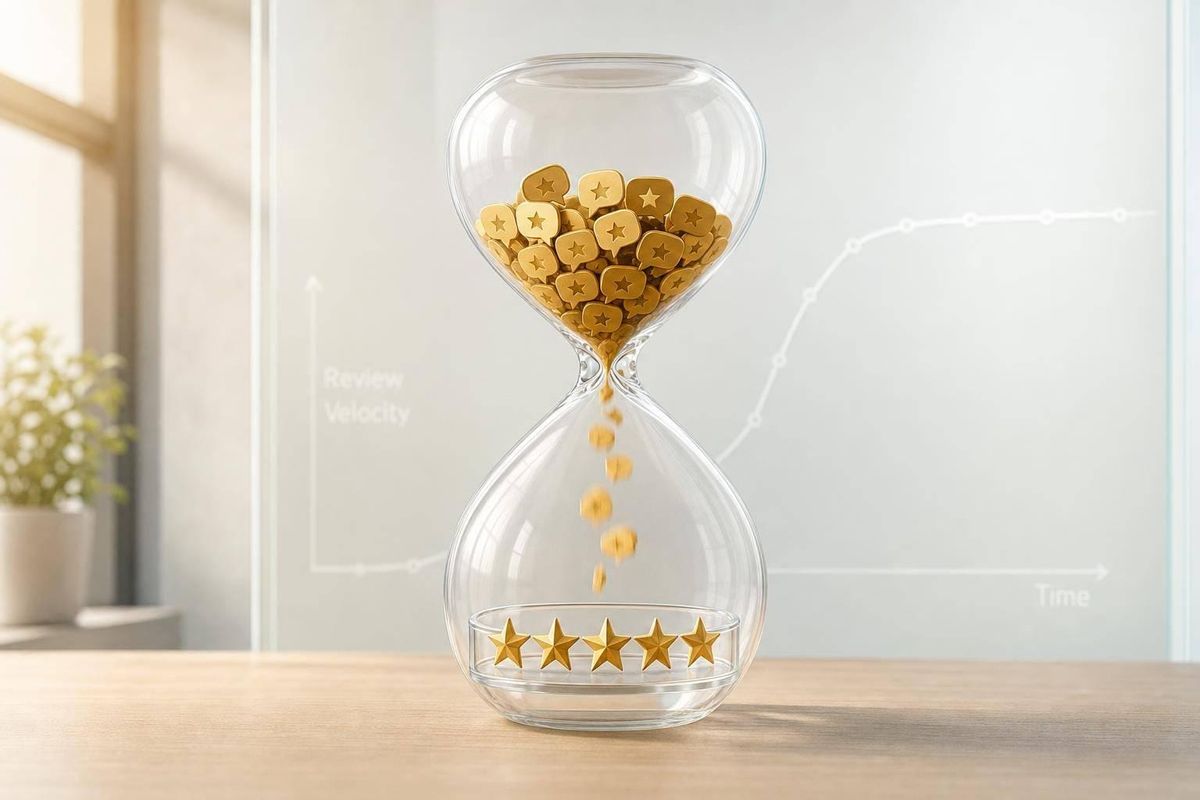
If I had to pick one rule, it’s this: early on, new reviews matter more; later, star rating matters more. For Shopify apps, I’d watch review pace first when an app has under 30 reviews, then shift more attention to rating score once the app has a solid base.
Here’s the short version:
- Review frequency shows current demand and recent merchant activity.
- Rating score shapes trust, click-through rate, and install rate.
- A stale 4.9-star app can lose ground to a 4.6-star app that keeps adding reviews each week.
- But once an app has 100+ reviews, a move from 4.2 to 4.6 stars can matter more than a small bump in monthly review count.
- High review volume with weak ratings can hurt both conversion and search position.
If I were managing ASO for a Shopify app (or comparing Shopify ASO tools to find the right stack), I’d use a simple rule set:
- Under 30 reviews: push for a steady flow of new reviews.
- 30 to 150 reviews: watch both, but fix rating drops first.
- 150+ reviews: protect score and keep review flow steady.
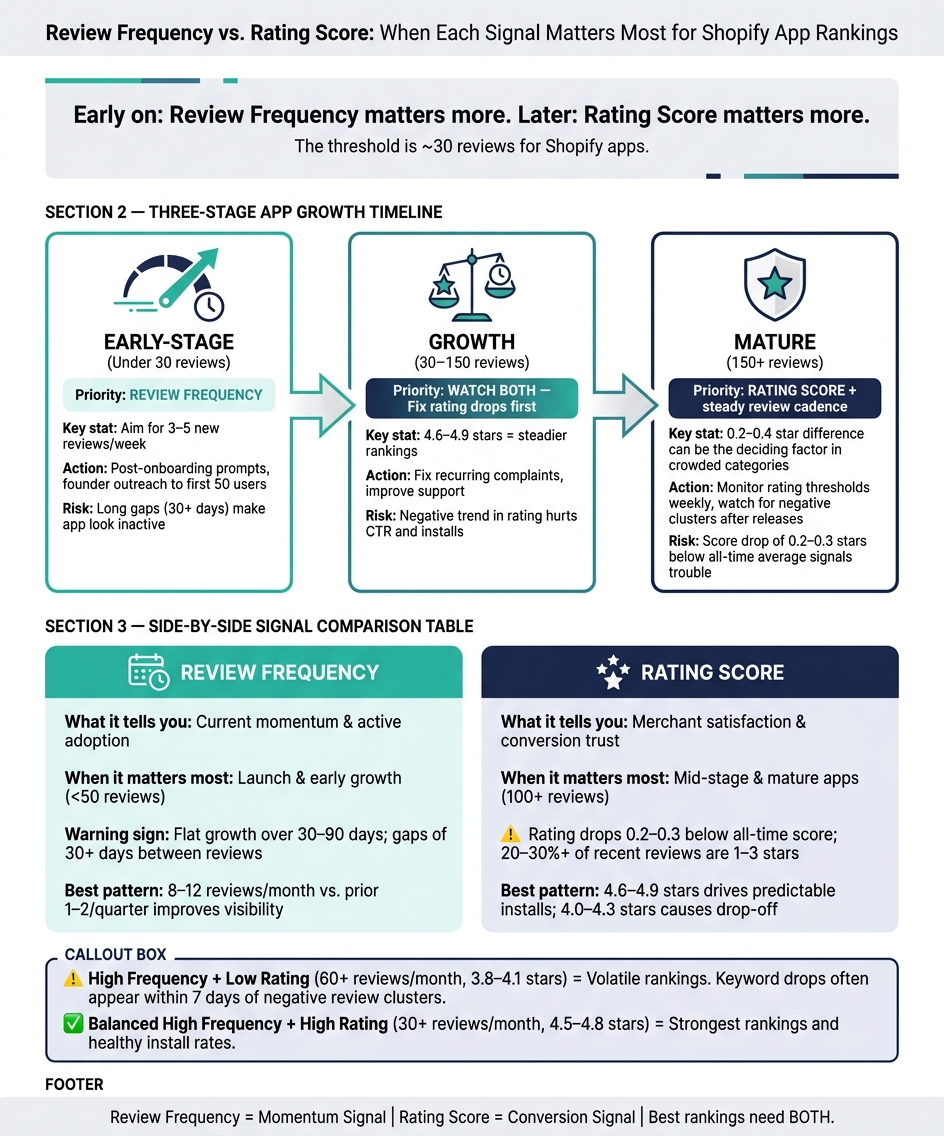
Review Frequency vs. Rating Score: When Each Signal Matters Most
How Average Review Rating Impacts App Ranking Position | SEO Insights - Shopify App Store

sbb-itb-ce93587
Quick comparison
| Signal | What it tells me | When it matters more | Main risk |
|---|---|---|---|
| Review frequency | Current momentum | Launch and early growth | Long gaps make the app look inactive |
| Rating score | Merchant satisfaction | Mid-stage and mature apps | Low stars cut clicks and installs |
In plain terms, I’d treat frequency as the momentum signal and rating as the conversion signal. The best rankings usually come from both working together. To see how these signals translate into visibility, you can track Shopify app rankings for specific keywords.
Review frequency: when fresh review activity drives visibility
Why recent reviews can outweigh old review volume
Review count matters. But timing matters too.
A big pile of old reviews shows history. A listing that’s getting reviews right now shows current use. And in many cases, that current pace affects visibility before star score affects trust.
ASO teams often watch reviews by week or month because review velocity says more about current merchant satisfaction than lifetime totals do. Fresh reviews point to current adoption and active merchant satisfaction. That’s the signal that matters when an app needs proof of traction now, not just a long track record.
In practice, review velocity matters most when the market is still judging the app’s momentum.
Cases where frequency matters more than score
Newly launched apps with fewer than 50 reviews are still trying to prove traction. Ranking systems look for signs that adoption is real, and a steady pace of 3–5 new reviews per week can show momentum more clearly than small changes in rating.
Apps in fast-changing categories - like AI tools, marketing automation, or influencer apps - deal with shifting merchant expectations. That means an app with 4.5 stars and 20–30 fresh reviews in the last 60 days may outrank a 4.8-star app with very few recent reviews.
There’s another common case: apps with solid product metrics but weak social proof. Moving from 1–2 reviews per quarter to 8–12 can improve visibility and click-through rate more than a slight bump in rating.
Warning signs of weak review momentum
Low total reviews aren’t always the problem. Stalled review growth is.
The clearest sign is flat growth over a 30- to 90-day window. If your total barely changed while similar apps in the same category picked up 10–20 new reviews during that same period, that gap can hurt rankings.
Gaps of 30+ days between reviews can point to two issues: the app isn’t asking for reviews, or new adoption isn’t happening at a steady pace. The pattern ASO teams should watch most closely is this one: keyword positions fall while the rating stays the same. When visibility drops but the star average holds, stalled review velocity is often the reason.
AppJubilee tracks review velocity, recency, and keyword ranking snapshots so teams can spot visibility drops fast. When review growth slows down, rating score becomes the stronger trust signal.
Next, the rating score matters most when trust and conversion depend on stable satisfaction.
Rating score: when average stars matter more than review velocity
How score affects ranking stability and installs
If review frequency shows momentum, rating score shows whether that momentum turns into installs.
Once an app has built up enough reviews, average rating starts to matter more than small swings in review pace. Merchants often look at star rating first. It’s the quickest trust signal on the page, and higher scores usually lead to better conversion when review volume is already there.
Apps in the 4.6–4.9-star range tend to keep steadier rankings and get more predictable installs. Apps in the 4.0–4.3 range often see lower click-through rates and more drop-off on listing pages. At that point, score is usually the stronger lever.
Cases where score matters more than frequency
For apps with an established review base, a small change in monthly review count usually matters less than a change in average stars. Moving from 4.2 to 4.6 stars can improve CTR and install conversion in a meaningful way, even if review volume stays flat.
This gap gets bigger in crowded categories. When several apps have about the same visibility and similar review counts, a 0.2–0.4 star difference often becomes the deciding factor for merchant choice. For high-intent searches like subscription app or bundling app, merchants tend to decide fast. In that situation, the higher-rated app usually gets more clicks, even if another option has slightly more recent reviews.
When more reviews reveal weaker quality
High review velocity isn’t always good news. If new reviews are dragging the average down, more volume can hurt instead of help. Keyword rankings often drop in the 7-day window after negative reviews, so a steady wave of low-rated feedback can pile up fast, hurting both score and visibility.
Two patterns stand out most:
| Signal pattern | Ranking and conversion effect |
|---|---|
| High frequency / low rating (60+ new reviews/month, 3.8–4.1 stars) | Volatile; a short-term velocity bump fades as the lower score hurts conversion and pulls rank down |
| Balanced high frequency / high rating (30+ new reviews/month, 4.5–4.8 stars) | Strongest; supports top rankings and drives healthy install rates through strong social proof |
AppJubilee's review intelligence tracks rating trends alongside keyword ranking snapshots, so teams can spot early signs of sentiment decline before a weaker average starts pulling down visibility.
The next step is deciding which signal to prioritize by app stage.
Review frequency vs. rating score: how to prioritize by app stage
What matters most changes as your app grows. The priority at launch usually isn't the same priority once you’ve built a steady stream of reviews.
Early-stage apps: build review momentum first
If you’re sitting below 20–30 reviews, put more weight on fresh review volume than on tiny rating shifts. In the first 60–90 days, the goal is simple: keep reviews coming in at a steady pace.
At this stage, a short-term drop from 4.8 to 4.6 stars is often less harmful than having only a few reviews with long quiet stretches in between. An app with sparse feedback can look unproven. That’s why momentum comes first.
The best move is to use compliant, well-timed prompts. Reaching out 7–14 days after install, once a merchant has had time to see real value, tends to lead to more genuine and more positive responses.
Established apps: protect score while keeping review cadence
Once you have enough review volume, the balance shifts. At that point, score stability usually matters more than small swings in monthly review count. Higher-rated apps tend to convert better from category pages and search results, even when review pace is about the same.
If your 30-day rating average falls 0.2–0.3 stars below your all-time score, or if more than 20–30% of recent reviews are 1–3 stars, stop pushing hard on review requests for a bit. Fix the issue behind the bad feedback first.
That could mean a buggy release, a support backlog, or a part of onboarding that’s rubbing users the wrong way. When that kind of pattern shows up, protecting rating score matters more than squeezing out extra review volume.
A simple decision model for ASO teams
The table below lines up common app profiles with the metric to watch and the next move to make.
| App stage | Review profile | Priority metric | Recommended action |
|---|---|---|---|
| Early-stage (<30 reviews) | 8 reviews, 4.6 stars, 1 review/month | Frequency | Post-onboarding review prompts, direct founder outreach to first 50 users, respond to all reviews within 48 hours |
| Growth (30–150 reviews) | 70 reviews, 4.3 stars, 6 reviews/month, negative trend | Rating score | Fix top recurring complaints, improve support processes, follow up with detractors before requesting updated reviews |
| Mature (150+ reviews) | 250 reviews, 4.8 stars, 10–15 reviews/month, stable | Protect both | Maintain existing review flow, monitor rating thresholds weekly, watch for negative clusters after major releases |
Use this model to choose between pushing volume and fixing quality first. Then pair it with keyword and review tracking for terms like product review so you can see which signal moves rank first.
Conclusion: the strongest rank impact comes from both signals working together
Put simply, review frequency builds momentum. Rating score turns that momentum into installs. The best-performing listings bring both together. If you want rankings that hold up over time, one signal on its own usually isn’t enough.
Recent review growth can shift visibility faster than total lifetime review count.
In practice, velocity without quality is a short-term move. If reviews keep coming in but the average score starts to slip, conversion rates can drop. And once that happens, ranking stability tends to slip too.
Key takeaways for Shopify app developers
Top Shopify listings tend to pair high ratings with a steady flow of new reviews. Early on, put more weight on frequency. Once you’ve built enough volume, guard your score closely without letting review cadence dry up. The strongest listings keep both working at the same time.
The key is linking review changes to ranking movement. AppJubilee helps Shopify app teams connect review changes to keyword movement and installs.
FAQs
How often should I track review velocity?
Track review velocity all the time, but judge it over a 7–30 day window instead of looking at daily swings.
For ranking impact, check the 7-day period after each review to spot review-to-rank patterns. Then verify that pattern over 30 days. A simple way to handle this is weekly monitoring with monthly review-velocity scoring.
Can a few bad recent reviews lower rank fast?
Yes. A few bad recent reviews can lower rank fast, mostly because of review velocity rather than one rating on its own.
In Shopify App Store rankings, a sudden cluster of negative reviews can show up before a drop in rank. That said, rank shifts during the same 7-day window can also come from listing edits, so reviews may not be the only cause.
What review goal should a new app aim for first?
A new app’s first review goal should be review velocity. Put simply: try to get 10+ reviews in the first 30 days.
The timing matters too. A good window to ask is 7–14 days after install. That gives people enough time to try the app before you ask for feedback.
Early on, review velocity matters more than total review count for ranking. Why? Because a steady flow of new reviews can help build early visibility in the store.
Without reviews, those first ranking signals are weak. It’s a bit like opening a store on a busy street with no foot traffic yet. The app exists, but the marketplace has less proof that people are using it and reacting to it.
It also helps to keep your listing fresh. Update the app about every 30 days so incoming reviews have a better chance of turning into ranking movement.