
Shopify App Install Attribution: Study Summary
Study of app install paths: paid and in-store search often start installs, partners close them, reviews confirm, GA4 can miss steps.
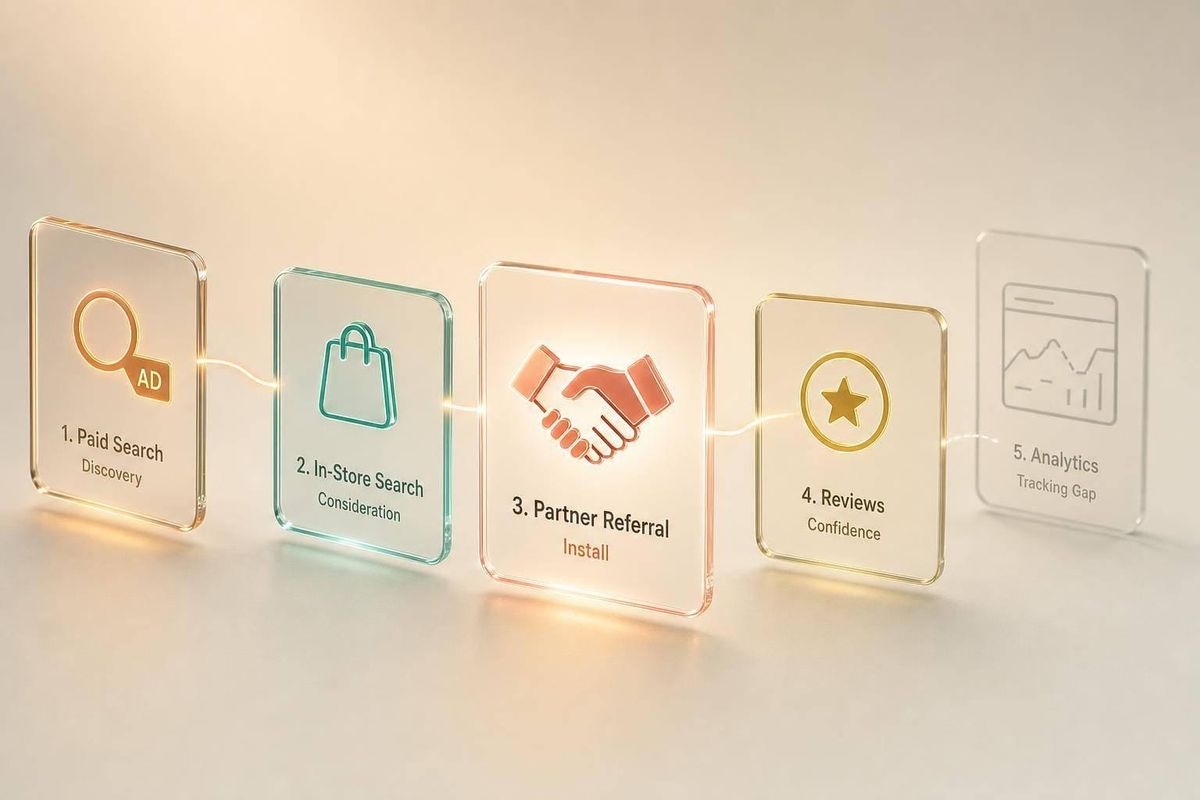
Most Shopify app installs do not come from one clean source. From what I see in this study, paid search and App Store search often start the journey, partner referrals often help close it, and reviews tend to show up near the end as a trust check. At the same time, GA4 can miss part of the path when tags are weak or merchants switch devices.
If you want the short version, here it is:
- Paid search often brings the first visit or a return visit.
- Shopify App Store search often shows high intent and appears early or late in the path.
- Partner traffic often converts in fewer steps because the merchant arrives with context.
- Direct / other often gets last-click credit, even when another source did more work earlier.
- Reviews usually help confirm the choice, not start it.
- GA4 shows the path it recorded, not the full reason someone installed.
A few numbers stand out. The article notes that App Store searches are often 2 to 4 words, which points to strong purchase intent. It also cites 807,000+ reviews across the Shopify App Store with an average of 4.70 stars. And one outside study found pages with 1 to 10 reviews were 52.2% more likely to convert than pages with none.
| Source | Usual job in the path | What to keep in mind |
|---|---|---|
| Paid search | Starts discovery or brings people back | Often loses final-click credit |
| App Store search | High-intent discovery and evaluation | Query data is limited |
| Partner traffic | Referral-driven installs | Paths are often shorter |
| Direct / other | Final visit before install | Can hide earlier influence |
| Reviews | Final trust check | Shows correlation, not proof |
So if I were reading Shopify app install data, I’d treat attribution as a path view, not a verdict. It helps show who introduced the app, who supported the choice, and where the data may be incomplete.
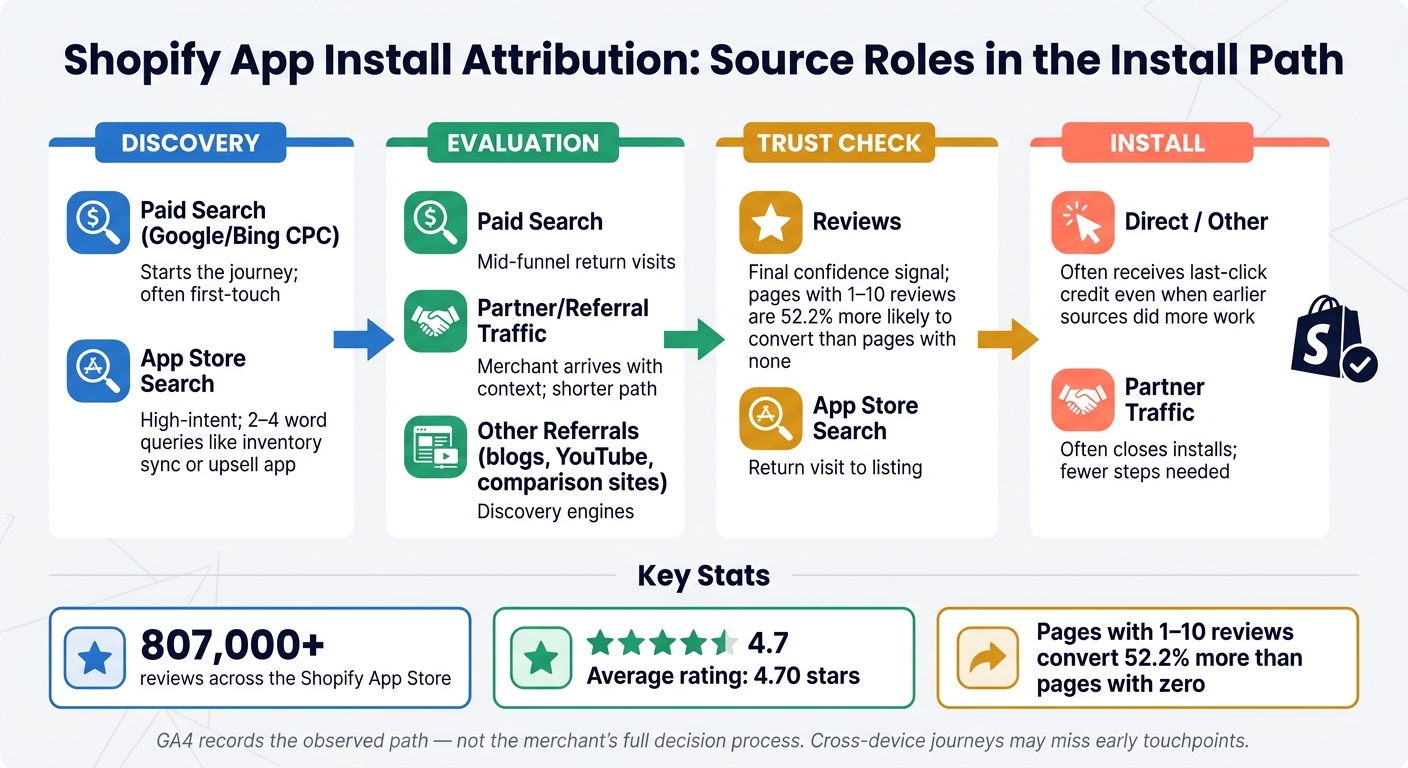
Shopify App Install Attribution: Source Roles in the Install Path
App Install Attribution Explained
sbb-itb-ce93587
Study Scope and Attribution Setup
This summary looks at Shopify App Store install source patterns for apps tracked in GA4 or Shopify Partners. The focus is on install-funnel paths. It does not cover long-term revenue, cross-device identity, or post-install results.
That distinction is a big deal. These are observed attribution patterns, not proof of why a merchant installed. Install paths depend on how GA4 records the session chain before the install. So the data shows the path GA4 captured, not the full thinking behind the merchant’s choice.
How Shopify App Store Installs Are Measured in GA4
Shopify sends a server-side shopify_app_install event to GA4 through Measurement Protocol, not as a browser event. That event is tied to merchant identifiers like shop_id, shop_name, and shop_url, which lets analysts connect installs to specific accounts.
For path analysis to work, those install events must link back to earlier sessions. That link depends on GA4 traffic-source dimensions like session_source, session_medium, and session_campaign being filled in correctly for sessions on the app’s marketing site before the merchant lands on the Shopify App Store.
If tagging is missing or messy, things can go sideways fast. And if a merchant switches devices halfway through the funnel, GA4 will often log the install as Direct or not set. When that happens, the recorded path can fall apart.
Put simply: GA4 shows the recorded path, not the merchant’s decision process.
The study can confirm the install event and rebuild the recorded pre-install session chain. What it can’t do is prove causation. It cannot show that one touchpoint directly caused the install.
The table below defines the source groups used in this summary.
Source Groups Included in the Analysis
These source groups map to GA4 source and medium fields, along with Shopify App Store referral metadata:
| Source Group | How It's Identified |
|---|---|
| Paid Search | medium = cpc or paid_search; source = google or bing |
| App Store Search | Referral from apps.shopify.com search or browse surfaces; surface_type = search |
| Partner Traffic | Known partner domains or explicit UTM tags such as utm_medium=referral and utm_source=partner_name |
| Direct / Other | source = (direct), medium = none, or unmatched referrals |
A few notes help here:
- Paid Search includes both brand and generic keyword campaigns.
- App Store Search covers in-store search behavior and category browsing, but GA4 does not show individual search queries.
- Partner Traffic is only clean when the referring domain or UTM tags stay consistent. If not, that traffic usually ends up in Direct / Other.
With the setup defined, the next section shows which sources most often start, assist, and finish install paths.
Install Source Mix and Path Patterns
No single channel owns the install path. Most Shopify app installs happen across a multi-touch journey, with different sources doing different jobs at different moments.
The pattern below shows where each source usually shows up: at the start, somewhere in the middle, or near the finish.
| Source category | Typical role in the journey | Intent level | Initiates or closes installs |
|---|---|---|---|
| Paid search | Early discovery or mid-funnel return visit | Medium to high | Often initiates; may also assist closing |
| Shopify App Store search | Active in-store discovery and evaluation | High | Often initiates or appears near closing |
| Partner traffic | Trusted referral and solution recommendation | High | Often closes or strongly assists installs |
| Other referrals or direct | Brand recall, repeat visit, or off-platform mention | Varies | Often receives final-click credit |
Paid Search Contribution
Paid search, whether through Shopify Search Ads or Google CPC campaigns, often helps merchants find an app for the first time or brings them back in the middle of the journey. Picture this: a merchant searches for "Shopify email marketing app" on Google, clicks an ad, lands on the app's site or App Store listing, and starts looking around. They may not install right away. Instead, they keep comparing options and come back later through another session or channel.
That’s why paid search often appears in attribution data as a first-touch or mid-funnel touchpoint, while final-click credit goes somewhere else, often direct traffic or App Store search. In plain English, paid search gets the ball rolling. It moves merchants from knowing they have a problem to thinking, "This app might solve it." If you're looking at GA4, assisted installs and path position reports usually give a much better picture of paid search's role.
App Store Search Behavior
Merchants who use App Store search are already inside the Shopify ecosystem and actively trying to solve something. Their searches are usually short and task-based - often 2 to 4 words - such as "inventory sync" or "upsell app". That kind of search points to high install intent.
Still, App Store search does not always get final-click credit, even when it plays a big part in evaluation. A merchant might search the App Store, open a few listings, leave without installing, and then come back a few days later through a direct visit or a bookmarked link to finish the install. In that case, direct traffic gets the final click, even though App Store search did much of the work. That’s why return visits matter so much in GA4 path reports.
Partner Traffic and Referral Paths
Partner-driven installs tend to look different from search-led installs. When a Shopify agency, consultant, or another ecosystem partner recommends an app, the merchant usually arrives with trust already in place and a clear sense of the problem they need to fix. They’re not starting from zero. They’re checking a recommendation.
Because of that, partner-led paths are often shorter. There are usually fewer comparison steps, and the referral has a stronger chance of being the last meaningful touchpoint before install.
Other referrals - blog posts, YouTube reviews, comparison sites, and community threads - often work more like discovery engines. A merchant reads a comparison post, clicks to an App Store listing, looks around, and then keeps researching before coming back later to install. In those cases, referrals often start the path or help it along, while final-click credit lands somewhere else. That return behavior is also the point where product review signals often start to matter.
Review Effects on Conversion Paths
Reviews usually don't start installs. But they often help finish them.
Once search or a referral gets a merchant to an app listing, reviews often serve as the last trust check. Discovery gets the click. Reviews help answer the final question: does this app fit my store?
| Path type | Typical behavior | Likely effect on install completion |
|---|---|---|
| Review-exposed path | Merchant sees ratings or reviews before install, scans recent feedback, and confirms fit for their use case | Higher confidence and stronger install completion likelihood |
| No review exposure observed | Merchant installs without visible review interaction, often from a high-intent link or branded search | Faster install in some cases, but with less visible trust reinforcement |
How Reviews Assist Install Completion
When merchants read reviews, they usually spend more time on the page, scroll further, and click into more review sections. That's due diligence. They're not browsing casually. They're checking whether the app feels right for their store.
And that extra review time often lines up with a more decisive install action.
Early reviews matter a lot here. PowerReviews found that pages with just 1–10 reviews were 52.2% more likely to convert than pages with none. On top of that, the Shopify App Store averages 4.70 stars across 807,000+ reviews. So merchants come in expecting strong social proof before they commit.
What Review-Assisted Paths Can and Cannot Prove
It's important to read review-exposed paths carefully, especially when monitoring for fake reviews. They show correlation, not proof of causation.
A merchant might see reviews on a later visit and then install, even if some other channel started the journey. So review visibility can support conversion as a trust signal, but it shouldn't be treated as the only reason an install happened.
That's why these paths are best read as attribution signals, not proof of causation.
Attribution Limits and Key Findings
Attribution Interpretation Limits
Put together, these patterns show where GA4 gives you a clean view and where it squeezes the journey into a smaller frame.
GA4 records install paths at the browser, device, and session level. That means cross-device journeys can miss the first touchpoint. If a merchant starts on one device and installs on another, that early step may not show up in the path.
Shopify App Store traffic also gets grouped into broad source buckets. So while you can see the general channel, you often can't drill down to the keyword or placement level. That's a big constraint if you're trying to figure out which search terms or in-store spots drove the visit.
Because of that, it helps to document the attribution model before you make any call. Otherwise, it's easy to compare numbers that aren't telling the same story.
Key Findings for Shopify App Teams
A few patterns stand out.
- Search-led sources show up most often in observed install paths, especially paid search and App Store search.
- Partner and agency referrals drive fewer sessions, but those users tend to convert faster because merchants already arrive with context.
- Review views often appear close to install, but they work more like a final check than the root cause.
For teams trying to tie these paths back to listing visibility, GA4 alone won't give the full picture. Keyword and review data fill in the gaps.
AppJubilee brings together GA4 and Shopify Partners data with keyword tracking, ranking snapshots, listing-change tracking, and review intelligence. That makes it easier to connect install paths with the visibility drivers behind them.
FAQs
Why does GA4 over-credit direct installs?
GA4 often gives direct traffic too much credit for installs. The main issue is simple: it can lose the context needed to tie an install back to the original click source.
As people move from outside sources, or even through parts of the Shopify ecosystem, to your app listing or landing page, referral data can get stripped out or dropped along the way. Once that happens, GA4 falls back to direct traffic.
And that creates a blind spot. Your actual App Store optimization work and marketing results are still driving installs, but the reporting may hide where those users came from.
How should I measure partner-driven installs?
Connect your Shopify Partners account to AppJubilee in Settings so it can sync daily install and uninstall counts on its own.
That gives you a clearer view of partner-driven activity alongside listing changes and ranking movement. You can also check 7-day and 30-day trends to gauge momentum and see how partnership efforts are affecting performance.
Do reviews increase Shopify app installs?
Yes. Reviews can help increase Shopify app installs because they can improve search rankings and boost visibility in the Shopify App Store.
More specifically, review velocity matters more than total review count. In plain English, that means how fast you keep earning new reviews. A steady stream of fresh feedback can signal relevance, support organic traffic, and help drive install growth.