
Shopify app reviews: Ranking study summary
Ratings, recent review pace, and fresh detailed reviews correlate with Shopify App Store visibility more than lifetime totals.

Reviews appear to help Shopify App Store rankings - but mostly through rating quality, recent review pace, and new review timing, not raw lifetime count. From what I see in this study, apps that add 10–50 positive reviews in 7–14 days can move up 3–10 spots on medium-competition keywords, while rating gains like 4.1 → 4.5 tend to line up with steadier movement over 7–21 days.
If you want the short version, here it is:
- Recent reviews matter more than old totals
- Higher ratings tend to line up with better visibility
- Detailed reviews help trust and installs more than rank alone
- Reviews by themselves rarely move hard keywords much
- You need daily rank tracking, review logs, and peer data to compare tools to test impact well
- Correlation is not proof that reviews caused the rank change
Here’s the main takeaway in plain English: if I were running a Shopify app, I would focus first on keeping ratings above category norms, then building a steady monthly review flow, and then getting more specific review text. Just adding more reviews is usually not enough.
A quick comparison of what seems to matter most:
| Review signal | What it tends to affect most | What I’d expect |
|---|---|---|
| Average rating | Visibility + click-through rate | Broader upward movement |
| Review pace | Keyword momentum | Best on low- to mid-competition terms |
| New review timing | Rank stability | Helps keep listings from going stale |
| Review detail | Trust + installs | More effect on conversion than search rank |
| Total review count | Baseline trust | Weak signal on its own |
Bottom line: I’d treat reviews as one part of Shopify App Store SEO, not the whole system. The pattern looks clear enough to test, but not clear enough to call a fixed ranking rule.
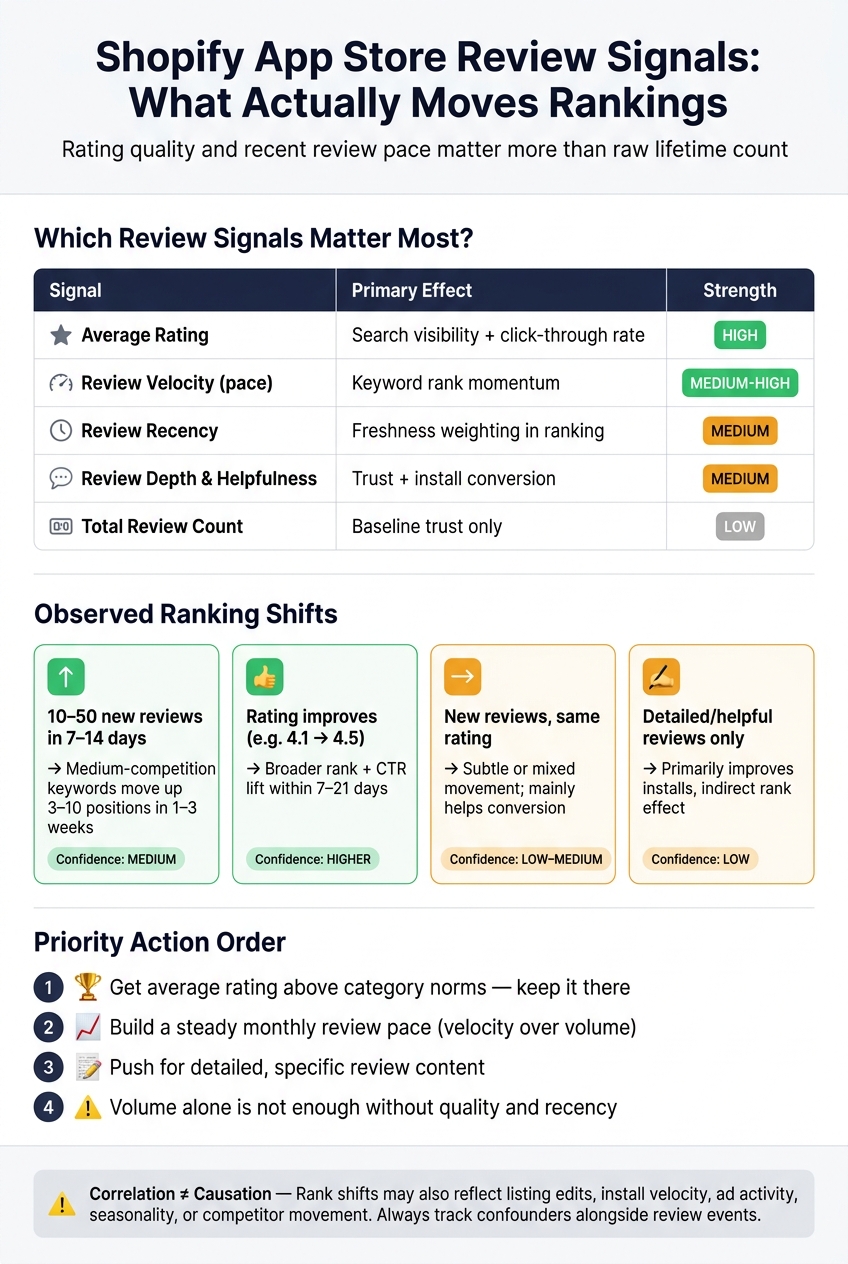
Shopify App Store Review Signals: What Actually Moves Rankings
Review signals that appear to move with keyword visibility
Three review signals show up again and again alongside stronger keyword positions: average rating, recent review volume, and review freshness. The pattern that shows up most often isn't total review count. It's recent review activity and rating quality.
Average rating, review volume, and recent momentum
Average rating is one of the clearest signals to track. Higher-rated apps often appear in featured placements like Staff Picks or Trending. Fresh, high-rated reviews can matter more than a large pile of old reviews.
Review velocity - the number of new reviews an app gets in a set period, like per month - often matters more than lifetime totals. In observed data, an app that gains 50 reviews in 30 days can beat an app sitting on 500 older, inactive reviews. Featured apps also tend to show steady monthly review growth. When category fit and keyword relevance are close, the app with more recent review activity tends to keep or improve rank more often.
That trend gets easier to see once you add recency and review depth to the mix.
Recency, helpfulness, and review depth
Beyond velocity, recency suggests that an app is still active and that reviews match its current state. A review from three years ago doesn't tell you much about today's support quality or feature set, and it's harder to spot fake reviews in older data sets. Shopify's ranking logic also seems to weigh reviews based on recency, helpfulness votes, depth, and how long the reviewer has used the app.
Review depth matters too. A detailed review that explains setup, support response time, or a clear result says much more than a one-line comment. Helpfulness votes can push those stronger reviews to the surface for both the algorithm and merchants browsing the listing.
Search ranking signals vs. listing conversion signals
Rank movement and listing conversion often shift at the same time, but they shouldn't be measured as one thing. Treat ranking and conversion separately: rank changes affect visibility, while CTR and installs affect listing performance. Connecting GA4 data to ranking snapshots helps split those two layers apart. If rank stays flat but installs go up, the review improvement likely helped conversion. If rank improves without much change in install intent, the signal may have helped visibility more than conversion.
The table below sums up which review changes are more likely to affect visibility versus trust.
| Signal | Primary Effect | Secondary Effect |
|---|---|---|
| Average rating | Search visibility | Merchant trust on the listing page |
| Review velocity | Keyword rank momentum | Signals recent activity |
| Review recency | Freshness weighting in ranking | Reflects current app quality |
| Review depth & helpfulness | Quality signal for ranking | Increases install confidence |
| Total review count | Weak ranking signal | Baseline trust indicator |
sbb-itb-ce93587
Observed ranking shifts after review changes
Once you know which review signals matter most, the next step is simple: what usually happens to rankings after those signals change?
In most cases, rankings don’t move by some neat fixed amount. They usually trend up, flat, or down. And the patterns below show what happens most often - not a promise of what will happen every time.
Common patterns in rank movement after review spikes
A burst of 10 to 50 positive reviews over 7 to 14 days will often lift medium-competition keywords by 3 to 10 positions over 1 to 3 weeks.
For low-competition or long-tail keywords, the jump can be bigger. An app might move from outside the top 50 into the top 20. But there’s a catch: those gains often wobble if installs and listing engagement don’t improve too.
On high-competition keywords, review spikes by themselves usually don’t do much heavy lifting. They rarely push an app into the top 10, and they often don’t move it much once it’s there. What teams tend to see is a small shift - about 1 to 3 positions - and even that can be tough to separate from normal week-to-week swings.
The strongest rank gains usually show up when review spikes happen at the same time as higher install velocity and better listing conversion. Reviews alone can help, but the movement is often smaller and fades faster.
Rating increases vs. fresh reviews with no star change
These two cases don’t behave the same way.
When an app’s average rating improves - say, from 4.1 to 4.5 stars - teams tend to see a broader and steadier upward shift. That lift usually shows up within 7 to 21 days and can improve both click-through rate and keyword positions.
But when the rating stays the same and the app simply gets a batch of newer, detailed reviews, the effect is weaker. It’s also harder to pin down. Some keywords may edge up a bit, while others don’t move at all. In that case, fresh reviews mostly help with trust and conversion. They’re not a strong solo ranking lever.
Review change type vs. expected ranking direction: comparison table
The table below sums up the most common review-change patterns by direction and confidence.
| Review Change Type | Observed Pattern | Confidence Level |
|---|---|---|
| Review count increase (burst of positive reviews) | Modest upward movement on medium-competition keywords; effect size varies | Medium |
| Rating improvement (e.g., 3.8 → 4.3 or 4.3 → 4.6) | More consistent rank and conversion lift; clearer signal across datasets | Higher |
| Newer reviews with same average rating | Subtle or mixed movement; hard to separate from normal volatility | Low–Medium |
| Helpful, detailed reviews | Primarily improves conversion; indirect and slower effect on rank | Low |
These confidence levels describe how often the pattern shows up across multiple apps and datasets. They do not describe the size of the effect. So even a higher-confidence pattern can still lead to small or delayed movement, depending on keyword competition, install trends, and what competitors are doing at the same time.
What the evidence supports and where it falls short
The rank patterns above are useful. But they’re still observational.
So it helps to split two things apart: what Shopify has documented about reviews, and what people have seen happen with rank movement.
| Evidence Level | What It Supports | What It Doesn't Support |
|---|---|---|
| Shopify's official docs | Review surfacing uses signals like recency, helpfulness, trust, and timeliness; positive reviews can help visibility | A published keyword-ranking formula tied directly to reviews |
| Shopify App Store observations | Rank often moves with review momentum and rating quality | Proof that reviews alone caused the movement |
That gap matters.
Shopify's review display logic is not the same thing as keyword ranking behavior. They may move in the same general direction, but they are not one-to-one.
Shopify review logic vs. keyword ranking observations
Shopify explains how reviews are sorted on the listing page: newer, helpful reviews from long-time users tend to show up first. That shapes what merchants see on the page. It does not tell us where the app will rank in search.
This is where people often get tripped up. They look at product review keyword data and assume those same rules control search position. That’s too big a leap. The two systems are related, but they are not the same system.
Why correlation is not the same as causation
Review changes almost never happen by themselves. A rank jump can show up at the same time as:
- Listing edits
- Install velocity
- Ad activity
- Seasonality
- Competitor movement
If a listing change happened during the same window as a review event, the ranking shift may have come from the listing edit, not the review itself.
There’s another limit here too: Shopify doesn’t publish its full ranking algorithm. So no one can assign exact weight to any single input with confidence.
What the evidence does support is a directional link. Higher ratings and a steady flow of new reviews often line up with better or steadier rankings. But the data points to correlation, not causation. The next section shows how to collect data and test that relationship cleanly.
Data to collect and how to read the results
Minimum dataset for a credible review-impact test
If you want to test the patterns above, put review signals and rank signals on the same daily timeline.
That means keeping daily records for rankings, review events, and possible confounders. Average rating by itself isn't enough to isolate impact. A 4.5-star average may look strong, but it doesn't tell you when things changed, why they changed, or whether something else caused the shift.
Here’s the minimum dataset to track:
| Data Category | What to Capture | Why It Matters |
|---|---|---|
| Keyword rankings | Daily position for each tracked keyword | Primary variable for measuring impact |
| Review events | Exact date, star rating, text length, review depth, helpfulness votes, whether the reviewer is an active merchant, how long the reviewer has used the app, whether the review was posted/edited/deleted, average rating, rating distribution, keyword mentions in the review text, and sentiment | Links rank movement to specific review changes and separates more reviews from better reviews |
| Developer responses | Response timing and response usefulness | Helps explain reputation and conversion effects |
| Listing changes | Title, description, screenshots, pricing, with timestamps | Identifies confounding variables |
| Install trends | Daily installs and uninstalls | Shows whether rank shifts line up with behavior |
| Competitor data | Peer app ranks, ratings, review velocity, and listing changes on the same keywords | Controls for broad market or algorithm shifts |
A small but important point: track review velocity, not just lifetime count. Recent review growth often matters more than an old total that barely changes.
Also, log listing edits with timestamps. If a review spike and a listing rewrite happen at the same time, you need that record to sort out what likely moved the needle.
Once your dataset is set, test it in fixed windows instead of staring at one-day swings and trying to guess what they mean.
How to set before-and-after test windows
Use a 14–30 day pre-event baseline, a 7–14 day post-event window, and a 30–60 day follow-up.
Define the review event before you look at the results, then lock the calendar windows in advance. For example, your event might be receiving 40 new reviews in 10 days while your average rating rises from 4.1 to 4.4. That step matters more than it may seem. It keeps you from cherry-picking dates that make the outcome look better after the fact.
You should also track 3–10 peer apps on the same keywords. This gives you a reality check.
- If all apps move together, the shift is probably market-wide.
- If only your app moves, the review signal looks stronger.
Decision rules for reading review-related rank changes
Treat a review event as meaningful only if 30–50% of related keywords move in the expected direction across the post-event window.
Why so strict? Because one keyword jumping for a day doesn't prove much. Rankings wiggle all the time. What you want is a pattern, not a fluke.
If ratings improve but rankings still don't move after 30–60 days, the bottleneck is likely conversion or competition, not reviews.
Review count growth by itself is often too weak to drive strong rank movement unless it also brings better recency and more text depth. If you do see rank changes without those signals, check listing edits or competitor activity first.
Finally, be careful with one-day rank jumps that happen at the same time as listing edits or major competitor moves. Those are mixed signals. Log them, but hold off on firm takeaways until the 14–30 day trend is easier to read.
Conclusion: Key takeaways for app teams
Put it all together, and the signal is clear: directional, not guaranteed. Review quality and recency seem to matter more than raw volume. Shopify appears to put more weight on recent, useful, trustworthy reviews than on star averages alone. That means a smaller batch of detailed, recent reviews may line up more closely with keyword visibility than a much larger pile of older or thinner reviews.
Review-driven rank lifts do happen, but they’re not consistent. A sharp jump in average rating or a wave of specific, detailed reviews can lead to modest ranking gains. But in other cases, apps and keyword groups may show little movement, or the change may take time to show up. Competitive pressure, listing edits, promos, and seasonal demand or shifts in advertising spend can all shape the result.
For teams deciding what to do next, the order is pretty straightforward. First, get your average rating above category norms and keep it there. Next, build a steady monthly review pace. After that, push for more depth and specificity in review content. Volume alone isn’t enough. If rating quality, recency, and detail are weak, the payoff tends to be limited.
Strong internal testing also matters. You’ll want daily ranking history, timestamped review event logs, competitor snapshots, and close tracking of confounders. Reviews can tilt the odds toward better visibility, but they don’t promise ranking gains.
FAQs
How many new reviews does it usually take to move rankings?
There’s no fixed number. On the Shopify App Store, rankings often react more to review velocity - how fast you pick up new reviews - than to your total review count.
For example, an app that gets 50 new reviews in 30 days can outrank one sitting on 500 older reviews with no recent activity. So instead of chasing some magic number, watch the pattern: do spikes in new reviews line up with ranking moves?
That’s usually the signal worth paying attention to.
Do ratings matter more than total review count?
Yes. Review velocity seems to matter more than total review count.
An app that picks up 50 new reviews in 30 days will often rank above one sitting on 500 older reviews with no new activity.
That said, overall ratings and total review volume still matter. But the momentum from new feedback looks like it carries more weight.
AppJubilee’s Review-to-Rank correlation feature helps you track ranking shifts in the 7 days after new reviews come in and separate those changes from listing updates.
What data should I track to test review impact?
Track keyword ranking shifts in the 7-day window after each new review. In AppJubilee, watch your net position delta - the average rank change across your tracked keywords - and your weighted delta, which gives more weight to terms already ranking near the top.
Focus on patterns, not one-off review-to-rank jumps. A single review usually doesn’t tell you much on its own. What matters is whether you see clusters of movement during that same 7-day window.
At the same time, check for listing edits. If your app title, description, or screenshots changed during that period, those updates may have played a role in the ranking shift too.