
App Store Copy vs Review Quotes: What Wins?
Copy drives discovery and clarity; merchant reviews drive trust and conversions—use each where the funnel needs them.
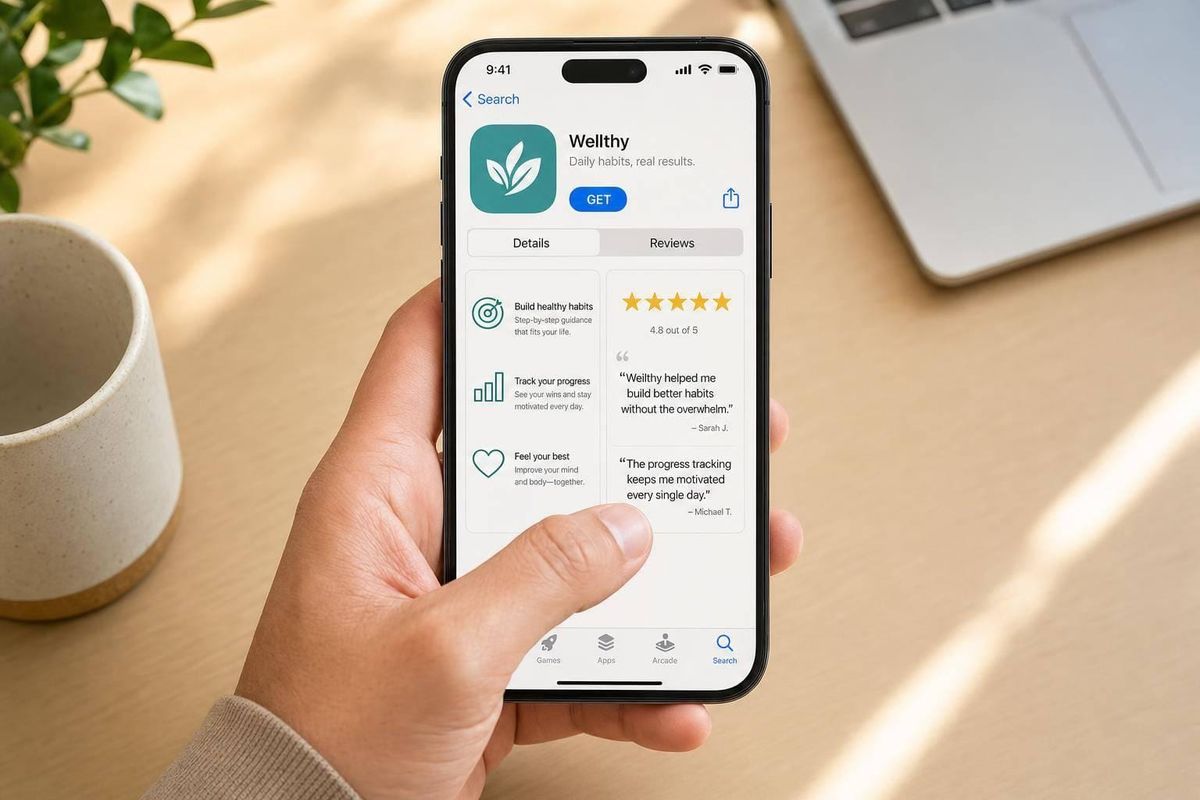
Short answer: app store copy wins for search and fit, while review quotes win for trust and conversion. If you run a Shopify app, you need both. As of mid-2026, the Shopify App Store had 17,891 active apps, so weak copy can hurt visibility and weak reviews can hurt installs.
Here’s the simple breakdown:
- Use copy to explain what the app does, who it’s for, pricing, setup, and limits
- Use review quotes to show proof from merchants, especially near install and pricing decisions
- On app listings, copy should lead and reviews should back it up
- On websites and ads, a short claim plus a review quote often works better
- For discovery, copy matters more
- For decision-making, reviews matter more
One data point stands out: listing updates tied to stronger keyword targeting improved rankings by an average of 8.3 positions. That tells me copy does more of the search work. Reviews do more of the “Should I trust this?” work.
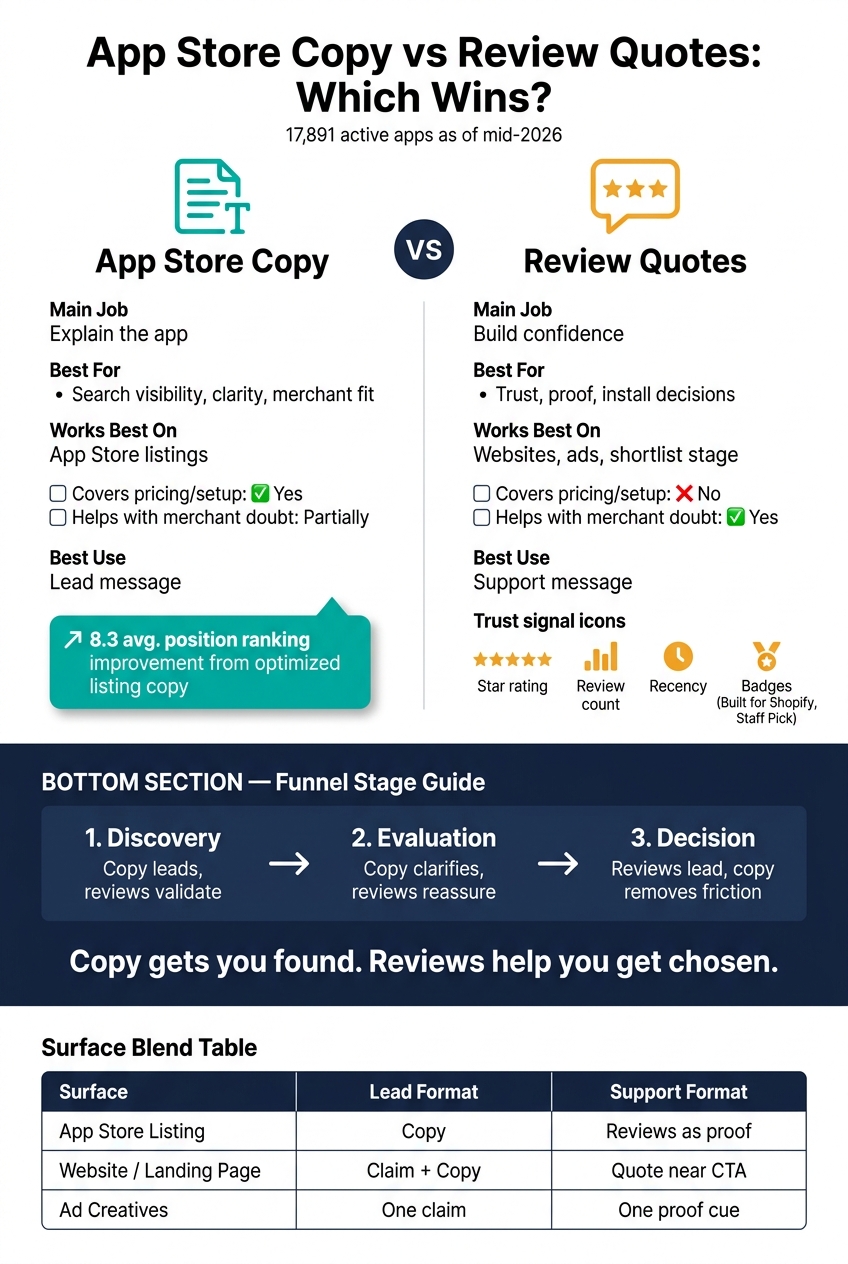
App Store Copy vs Review Quotes: Which Wins by Funnel Stage?
Quick Comparison
| Area | App Store Copy vs Review Quotes | | --- | --- | --- | | Main job | Explain the app | Build confidence | | Best for | Search, clarity, fit | Trust, proof, install decisions | | Works best on | App listings | Websites, ads, shortlist stage | | Covers pricing/setup well? | Yes | No | | Helps with merchant doubt? | Somewhat | Yes | | Best use | Lead message | Support message |
If I had to sum it up in one line, it’s this: copy gets you found; reviews help you get chosen.
sbb-itb-ce93587
Where product-led copy wins
How app store copy supports search visibility and merchant clarity
When a merchant opens a listing, the copy has to answer one question fast: Does this app fit my store?
The title, tagline, opening lines of the description, and scannable bullets do most of that work. A benefit-first title like "Recurring orders for subscription brands" tells the merchant what the app does and who it serves right away. A brand name by itself doesn't do that.
Shopify's algorithm looks at keyword relevance in the app title and description to match merchant search intent. In AppJubilee's 2026 research, optimized listing changes led to an average ranking improvement of 8.3 positions. Shopify's guidelines back this up: the app introduction and details should focus on benefits in plain language, without superlatives, unverifiable stats, or keyword stuffing.
That puts copy at the center of search visibility and merchant fit. Reviews start to matter more later, when the main question shifts from what does this app do? to can I trust it?
Copy handles complex features, pricing, and setup details better than reviews
Reviews are hit or miss. One merchant may love how easy an app feels. Another may point out a narrow edge case. Neither one gives a full picture of how the app works, what it costs, or whether it fits a store's setup. Structured listing copy fills that gap.
This matters most for complex apps like subscriptions, shipping logic, or integrations. In those cases, merchants need a plain explanation of setup steps, required integrations, and store fit before they install.
Shopify requires all pricing details to appear only in the dedicated Pricing section. Copy needs to spell out tiers, usage caps, trial length, and charge triggers clearly in U.S. dollars. Limits should be just as direct. Lines like "best for stores with 1,000+ SKUs" or "requires a Google Analytics 4 account" help merchants rule themselves in or out before they install. Clear pricing and setup requirements cut down on bad-fit installs.
Once those basics are clear, review quotes can do the trust work that copy can't.
Copy explains the app; review quotes supply the trust to click Install.
Where review quotes win
Reviews build trust that product copy cannot create on its own
Review quotes tend to hit hardest in the mid-to-late funnel, once a merchant already knows the app category and is weighing a shortlist of options. At that point, the question shifts. It’s no longer, “What does this app do?” It becomes, “Will this work in a store like mine?”
That’s where reviews earn their keep. Merchants want proof that the app works for businesses like theirs, not just polished claims from the brand. And because product copy is promotional by nature, review language often feels more believable.
The trust signals merchants look at first are pretty simple:
- Star rating
- Review count
- Recency
- Badges like Built for Shopify or Staff Pick
These act as fast trust filters. A strong rating helps. A solid review count adds weight. Recent reviews show the app is still active. Badges signal that the app is maintained and taken seriously.
What gives merchant language extra punch is specificity. Reviews often talk about results in plain business terms: lower support ticket volume, higher average order value, or faster setup. That kind of wording gets straight to the issues merchants care about most. How hard is setup? Will I need a developer? Will it hold up during Black Friday and Cyber Monday?
"Customer wording often communicates usability, support quality, and time-to-value more directly than brand-written copy." - AppJubilee
The best review quotes sound natural, specific, recent, and linked to a clear merchant outcome.
Review quotes work best on website pages and ad creatives
On an app listing, reviews help confirm what the copy already says. On websites and ads, they can do more of the heavy lifting. That’s the big difference. On listings, copy usually leads. Off-site, quotes often should.
On landing pages and pricing pages, a short merchant quote works well next to the main claim or CTA. Put a concise outcome statement near a price card, and it can ease hesitation right when pricing concerns pop up. In paid social and retargeting ads, short overlays with star ratings, review counts, or a measured result can beat feature-heavy creative because they deliver proof in a format people can scan fast.
The quote should match the funnel stage. Prospecting ads do well with broad trust cues like star ratings and review counts. Retargeting ads usually work better with time-to-value proof from merchants who already visited the listing but didn’t convert.
That’s why strong teams pair the claim with the proof. The message lands better when both show up together.
How high-converting teams use both formats together
Copy explains the product. Review quotes show that the claims hold up. What should lead depends on where the message appears. On listings, lead with explanation. On websites, lead with the claim and support it with proof. On ads, keep it fast and sharp.
| Surface | Primary Role of Copy | Primary Role of Review Quotes | Recommended Blend |
|---|---|---|---|
| App Store Listing | Explain features, pricing, and merchant fit | Provide proof of outcomes and support quality | Copy-led, with reviews as proof |
| Website / Landing Page | Establish the value proposition and the claim | Reduce friction near pricing and CTA buttons | Lead with the claim, then add a quote or rating signal |
| Ad Creatives | Capture attention with a specific outcome | Build instant trust in a cold-traffic environment | Lead with one claim and one proof cue |
On app listings: copy explains, reviews confirm
The listing is where copy carries most of the load. Your title, subtitle, and description need to answer three questions right away: What does this app do? Who is it for? What should I expect after installing it?
After the copy sets the stage, reviews help remove doubt. Add review snippets to the long description, especially around complex features, integrations, or onboarding steps. That way, the page reads like a clear product pitch backed by merchant evidence. It also helps to mirror the review themes that come up again and again in the description, screenshots, and feature order.
On websites and ads: lead with the claim, follow with proof
Off-site, people make decisions faster. So proof needs to show up earlier. One of the most reliable setups is simple: a short, outcome-focused headline followed right away by a merchant quote that backs it up.
Placement matters just as much as wording. Put proof closest to the friction point. A quote near a pricing card, a star rating next to an integration claim, or a short testimonial above the install CTA can cut hesitation right when it starts to creep in. In ads, less is more: one clear claim and one proof cue. If you pile on too many messages, both lose force.
Use AppJubilee review intelligence to sharpen both formats
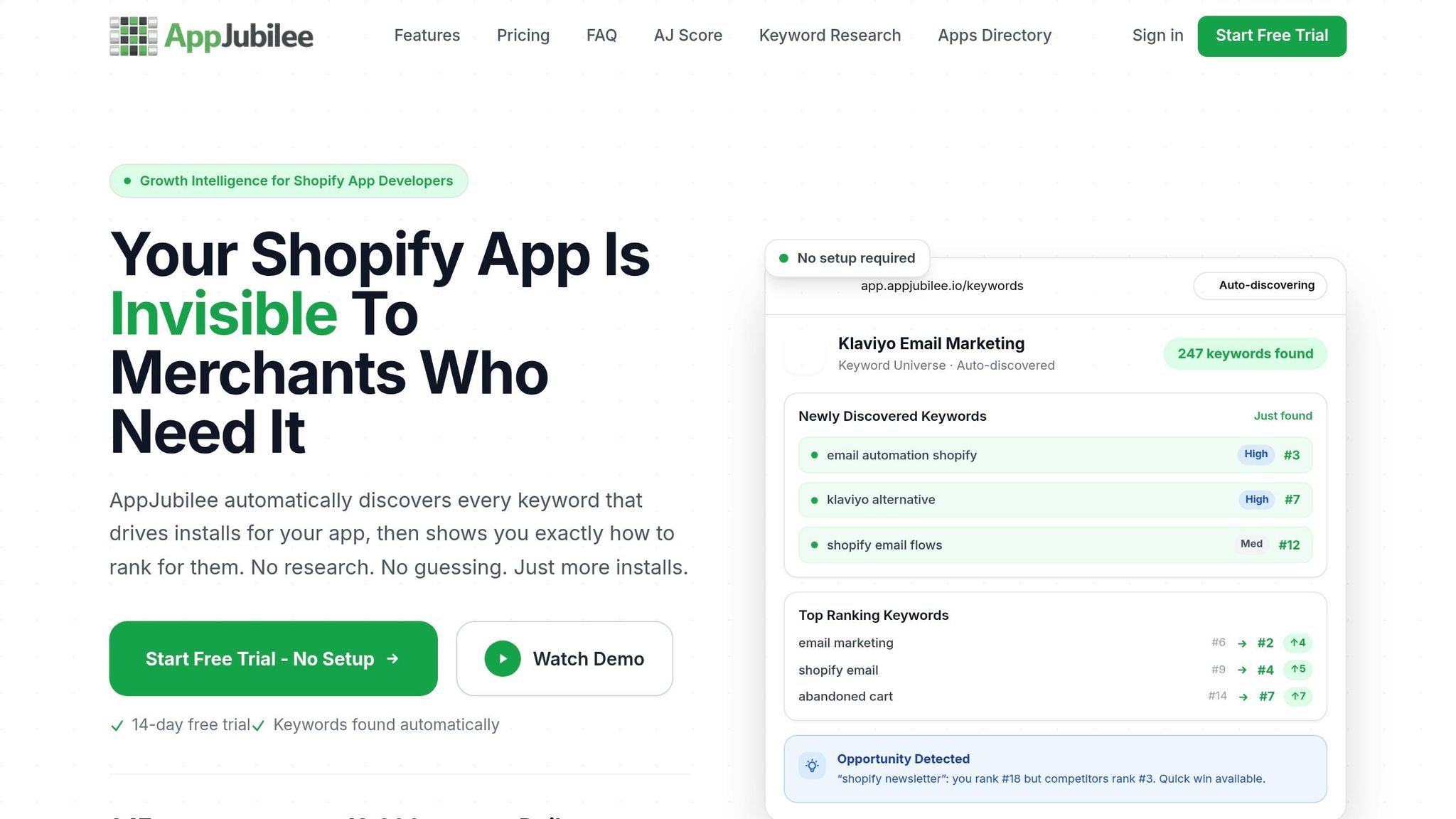
AppJubilee's review intelligence and listing change impact tracking bring recurring review themes to the surface and show how listing updates affect keyword rankings. That turns guesswork into a measured workflow. With that feedback loop, each update gets tighter and more on target.
Conclusion: The winner depends on the surface and funnel stage
There isn't one clear winner here. Product-led copy and review quotes play different roles, and strong Shopify app teams use each one on purpose based on where a merchant is in the funnel. So the better question isn't which format wins overall. It's which format should take the lead on each surface.
Match the format to the stage. Copy should lead during discovery and evaluation. Review quotes should lead when a buyer is close to making a choice and needs trust more than explanation.
Discovery: copy explains, reviews validate. Evaluation: copy clarifies, reviews reassure. Decision: reviews lead, copy removes last-mile friction.
Audit each surface by funnel stage, then swap the lead format when trust becomes the main job instead of explanation. AppJubilee can surface the keywords and review themes that help with both discovery and trust.
The best-performing pages and ads line up format with intent: copy for clarity, reviews for confidence.
FAQs
How do I balance copy and reviews on one app listing?
Use product-led copy to show what your app does and why it matters. Then back it up with reviews that help build trust and drive installs. Your copy should speak to clear merchant pain points and include high-intent workflow keywords so the right merchants can find your app.
If merchants land on your listing but don’t install, there’s often a disconnect. The copy may not match the solution they expected to see. A smart fix is to line up your messaging with the specific problems mentioned in your strongest, most relevant reviews.
What makes a review quote strong enough to use in ads?
A review quote works well in ads when it speaks to a specific merchant pain point or clear outcome, not just vague praise.
If you want more clicks, pick quotes that use the same workflow terms your audience searches for, like "UGC" or "returns and exchanges." That kind of wording helps people feel, right away, that the ad fits what they need.
AppJubilee can help you spot which problems your top-performing keywords point to, so you can pair quotes with the solutions people are already looking for.
When should I update copy versus focus on getting more reviews?
Update your listing copy every 30 to 60 days so it doesn’t go stale. This gives you a chance to tighten your messaging and work in high-intent, problem-based keywords in the title and description, which can help more of the right people find your app.
You should also pay close attention to review velocity. If the pace starts to slow, put more effort into getting new reviews. For new apps, a good target is 10+ reviews in the first 30 days. If your app is more established, the goal shifts to keeping a steady stream of fresh feedback coming in.