Keyword Rank vs Installs: Shopify App Store Data
Compare keyword rank and installs in the Shopify App Store and learn how to diagnose visibility vs conversion gaps.
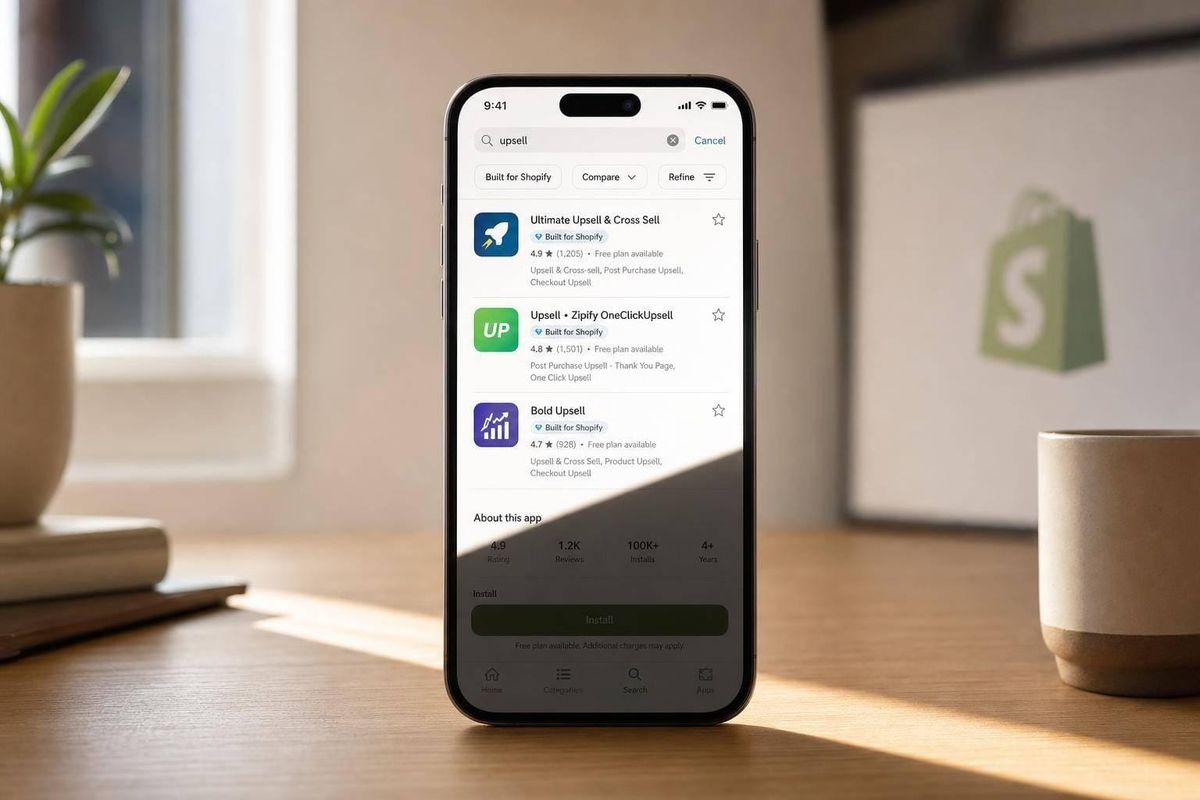
High rank does not always mean more installs. In the Shopify App Store, rank shows whether merchants see your app, while installs show whether they pick it. If you want more growth, I’d watch both together.
Here’s the short version:
- Top rankings get most of the demand. One data model shows rank #1 gets about 34% of daily organic installs, while ranks 31–50 get about 2%.
- Intent changes everything. A top spot for a term like “Shopify subscription app” will often drive more installs than a broad term like “marketing.”
- Your listing still decides the outcome. Reviews, rating, screenshots, pricing in USD, and clear copy all shape whether a click turns into an install.
- A gap between rank and installs is a signal. High rank with low installs often points to weak keyword fit, weak click-through, or a weak listing page.
- The fix depends on the bottleneck. Low rank + strong conversion means you need more visibility. High rank + weak conversion means you should fix the listing or target better terms.
If I were reviewing this data and comparing Shopify ASO tools, I’d map each keyword through a simple funnel: rank → impressions → CTR → listing views → install rate → installs. That makes it easier to see whether the problem is visibility, clicks, or conversion.
| Situation | What it usually means | What I’d check first |
|---|---|---|
| High rank, low installs | Poor keyword fit or weak listing | Search intent, screenshots, reviews |
| High rank, low clicks | Weak search-result appeal | App name, subtitle, rating, ad pressure |
| Low rank, strong install rate | Good fit but low visibility | Rank gains on core terms |
| Page 2+ rank, near-zero installs | Not enough exposure | Page 1 keyword targets |
The main idea is simple: rank shows visibility, installs show fit. When those two numbers drift apart, the gap tells you what to fix next.
How to rank high in the Shopify AppStore - App Store Optimisation
sbb-itb-ce93587
When Higher Keyword Rank Leads to More Installs
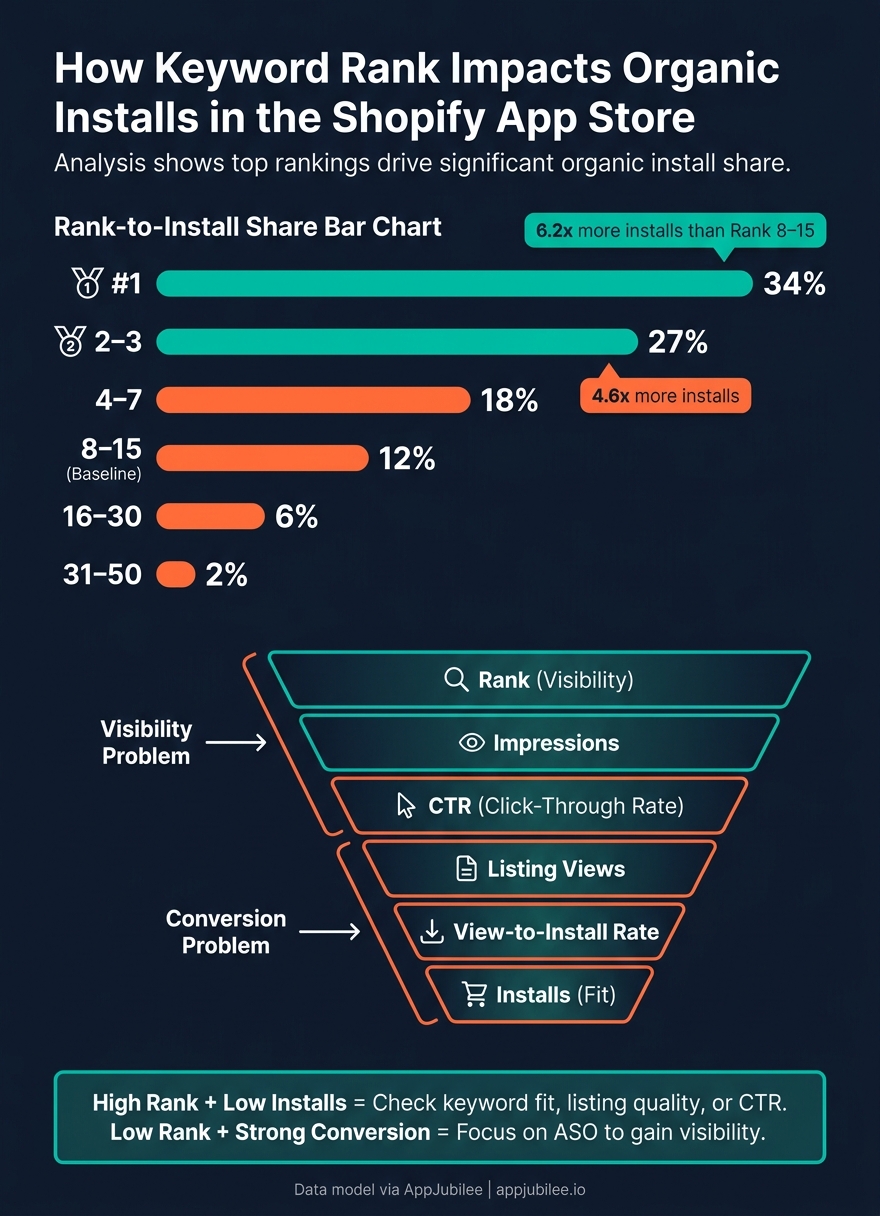
Shopify App Store: Keyword Rank vs. Organic Installs Distribution
Higher rank tends to pay off most at the very top of search results.
Why Top Positions Capture More Search Demand
Most merchants look at the first few results, then move on. That simple behavior creates a sharp drop in impressions and installs as listings slide down the page.
One rank distribution model shows just how steep that curve is: rank #1 gets about 34% of daily organic installs, ranks 2–3 get about 27%, ranks 4–7 get about 18%, ranks 8–15 get about 12%, ranks 16–30 get about 6%, and ranks 31–50 get about 2%.
| Rank Band | Share of Daily Organic Installs | Relative to Ranks 8–15 |
|---|---|---|
| Rank 1 | ~34% | 6.2x more installs |
| Ranks 2–3 | ~27% | 4.6x more installs |
| Ranks 4–7 | ~18% | 2.4x more installs |
| Ranks 8–15 | ~12% | Baseline |
| Ranks 16–30 | ~6% | - |
| Ranks 31–50 | ~2% | - |
So if an app moves from rank 9–10 into the top 3, installs can jump fast. That jump matters most when the keyword lines up with buying intent.
How High-Intent Keywords Turn Rank into Installs
Not all rank gains are equal. They tend to convert best on high-intent keywords.
If a merchant searches for "Shopify subscription app" or "post-purchase upsell Shopify," they usually know what they want already. They’re not casually browsing. They’re hunting for a tool that solves a clear problem. A top-3 spot on searches like these puts your app in front of merchants who are much closer to installing. That’s why moving up on high-intent terms often drives a stronger lift in installs than climbing on broad discovery terms like "marketing" or "apps."
These searches also tend to convert at a better rate. When the app’s title, category, and value proposition line up cleanly with the search term, search visibility is more likely to turn into clicks and installs. And those installs can help support later rank gains.
When intent is weaker, your listing has to carry more of the load.
How Listing Quality Turns Visibility into Installs
When rank is strong and keyword intent is strong, listing quality often decides what happens next.
Rank gets the click; the listing gets the install.
Merchants lean hard on social proof, so review count and average rating matter. You can analyze how competitors rank for product review keywords to see how social proof impacts their visibility. If reviews are weak or the rating is low, strong rank may not help much. Screenshots matter too. Merchants want to see the product in action, not just a logo and a vague tagline. Clear visuals that show the workflow help them judge fit fast.
Messaging plays a big part as well. A short title and subtitle tied to the merchant’s goal can make the match obvious. For example, "Recurring subscriptions for Shopify" speaks directly to someone searching "Shopify subscription app." That kind of alignment removes friction. Pricing clarity helps too. Showing pricing in USD, along with trial terms and what each plan includes, can cut drop-off.
"Review velocity is a strong signal of install momentum and often precedes ranking improvements." - AppJubilee
Stronger listings turn more impressions into installs, and those installs can help support later rankings.
When Strong Rank Does Not Produce Installs
The next step is figuring out why strong visibility still doesn't turn into installs.
A high rank can look great on paper and still do very little for growth. In most cases, the gap comes from three places: keyword fit, search-result appeal, or listing conversion.
Ranking for the Wrong Keywords
Not every keyword that gets your app seen will get it installed. broad terms or feature-led phrases can bring visibility without bringing people who are ready to install. Merchants often search using problem-based language, not product jargon.
That’s why core keyword coverage matters so much. If an app ranks well for side terms but misses the keywords that most apps in its category target, it may be getting in front of the wrong people. High visibility with low installs is often a sign that search intent and audience intent don’t line up.
Low Click-Through from Search Results
Even a top organic position can lose clicks if the app name, subtitle, or category doesn’t show relevance right away. Searchers scan fast. If the listing doesn’t make sense at a glance, they move on.
Paid placements above organic results can also eat into CTR. So if rankings look strong but clicks stay soft, it helps to check how much ad competition is showing up for those terms.
Tracking paid ad pressure on your top-ranking keywords can help explain why click-through rates sometimes trail rank.
Low View-to-Install Conversion on the Listing
Sometimes merchants do click, but they still don’t install. When that happens, the listing is usually the bottleneck. Weak screenshots, fuzzy value props, or old reviews often cause the drop-off.
Looking at these funnel patterns makes it easier to see where the problem sits: visibility, clicks, or conversion.
| Funnel Pattern | Likely Cause | Metric to Inspect |
|---|---|---|
| High Rank, Low Clicks | Weak search-result appeal or paid ad pressure | Click-through rate and ad pressure |
| High Rank, Low Installs | Poor search intent match; ranking for non-core keywords | Keyword intent match |
| High Views, Low Installs | Weak screenshots, reviews, or vague use cases | Listing conversion rate |
| Page 2+ Rank, Near-Zero Installs | Lack of meaningful visibility | Ranking quality (Page 1 presence) |
"Page 2 rankings rarely drive installs." - AppJubilee
How to Read the Visibility-to-Install Gap in Shopify App Store Data
A steady funnel makes it much easier to see why one keyword drives installs and another stalls out.
Build a Keyword-to-Install Funnel
Map each keyword through the same path so you can spot where strong rank stops turning into installs.
Track it like this: rank → impressions → CTR → listing views → view-to-install rate → installs.
Then look at the ratios. They tell you where the leak is:
- Low CTR usually points to a search-result issue
- Low view-to-install rate usually points to a listing issue
The key is to read those numbers together, not in isolation. A 3% CTR on a rank #2 keyword is a strong sign that the search snippet isn't doing its job. That could mean the title, rating, or category fit isn't landing with merchants.
Separate Visibility Problems from Conversion Problems
A simple rule helps here: low rank + strong conversion = visibility problem; high rank + weak conversion = intent or listing quality problem.
Sort each keyword into the pattern that best fits its funnel data.
| Pattern | What It Means | Where to Focus |
|---|---|---|
| Rank #18, CTR 10.5%, View-to-Install 22% | App converts well, but almost no one sees it | Improve rank; find more high-intent keywords |
| Rank #3, CTR 4.2%, View-to-Install 7.1% | Strong visibility, but merchants aren't biting | Fix the listing or reconsider keyword fit |
| Rank #4, CTR 11.2%, View-to-Install 21.5% | Healthy funnel; small rank gains can pay off | Push rank higher to capture more volume |
When conversion metrics are strong but rank is low, putting effort into ASO to move up the results will likely turn into more installs. If rank is already high but conversion is weak, work on the listing first instead of chasing an even higher position.
Use AppJubilee, Shopify Partner Data, and GA4 Together
Once you know the bottleneck, use each tool for the part of the funnel it shows best.
No single data source shows the whole path on its own. AppJubilee appjubilee.io tracks keyword rank and rank movement over time. Its listing change impact tracking shows how a title or description update affects rankings over the next seven days, which helps tie your edits to the movement that follows.
GA4 adds post-click traffic and behavior data, while Shopify Partners gives you install counts. Put the three together, and the picture gets much clearer: a rank shift in AppJubilee, a matching traffic change in GA4, and then a change in installs inside Shopify Partners.
Conclusion: Use Rank to Find Traffic and Installs to Judge Fit
Rank tells you how visible you are. Installs tell you whether the keyword and listing are a good match.
That difference matters. Rank sets your traffic ceiling, but it only helps when the keyword and listing line up with merchant intent. The gap usually comes down to two things: listing quality and keyword-to-product fit. So rank isn't just a reporting metric. It's a way to diagnose what's going wrong.
Use that gap to decide what to fix first. Pick a core set of keywords, track rank and installs on a steady schedule, and review each keyword on its own. When you see a gap, you can tell whether the issue is the listing or the ranking.
Rank shows visibility. Installs show fit. Use the gap to decide what to fix.
FAQs
Why do high rankings sometimes get few installs?
High rankings can still bring in very few installs if you’re showing up for the wrong merchants or your listing doesn’t persuade people to act.
In the article, this shows up in two common ways:
- High impressions but low CTR: people see the app, but the title or subtitle doesn’t line up with what they searched for.
- High clicks but low installs: people tap through, but the keyword suggests a problem your app doesn’t actually solve.
You can also spot trouble when early uninstalls spike or reviews don’t back up the problem tied to that keyword. Those signals can drag install performance down.
Which keywords are most likely to drive installs?
Keywords with high merchant intent are the ones most likely to drive installs, especially problem-based and solution-based terms. Broad category keywords like marketing can help with visibility, but they often bring weak conversion rates.
Put your focus on specific long-tail keywords tied to clear pain points, like abandoned cart recovery or product bundles discount. Branded keywords and tool-first terms can also work well for merchants who are ready to switch.
How can I tell if my problem is rank or conversion?
Look for a mismatch: keyword rankings stay flat or move up, but install conversion from that traffic drops.
Common signs include:
- High impressions with low CTR
- High clicks with low installs
- Installs followed by more uninstalls within 7 days
That usually points to a conversion issue, not a rank issue.