
Tiered vs Usage-Based Pricing For Shopify Apps
Use tiered plans for fixed monthly bills, usage-based when value tracks volume, or hybrid to balance predictability and growth.

If I had to boil it down to one line: use tiered pricing when merchants want a fixed monthly bill, use usage-based pricing when your app’s value tracks volume, and use a hybrid model when you need both a revenue floor and room to grow.
Before I pick a pricing model, I look at three things:
- What merchants pay for: access to features, or activity like orders, emails, SMS, or API calls
- What my costs do: stay flat each month, or climb as usage climbs
- What the category expects: fixed plans, metered billing, or a mix of both
Here’s the short version:
- Tiered pricing gives merchants a set monthly price like $29/month or $99/month
- Usage-based pricing makes the bill move with activity, which can mean higher upside but less stable monthly revenue
- Hybrid pricing mixes a base fee with overage charges, like $19/month plus $0.01 per order after an included amount
- Tiered plans are easier to scan in the Shopify App Store
- Usage-based plans need cost examples, spend tracking, and clear billing rules to avoid bill shock
- Shopify billing caps matter because merchants approve a maximum charge for each 30-day cycle
- Seasonality matters in the U.S. market, especially around Black Friday and Cyber Monday, when volume can jump fast
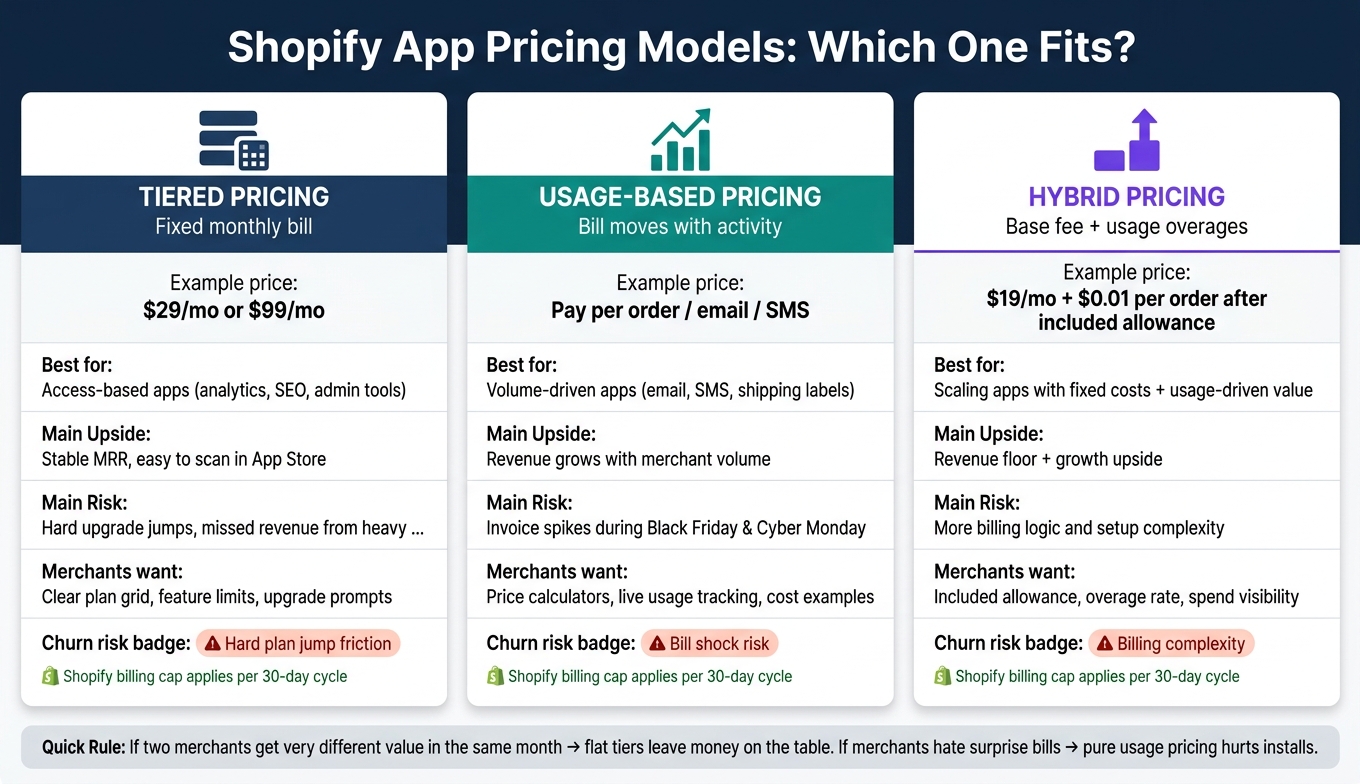
Tiered vs Usage-Based vs Hybrid Pricing for Shopify Apps
Quick Comparison
| Model | Best for | Main upside | Main risk | What merchants want to see |
|---|---|---|---|---|
| Tiered | Apps sold by access, features, seats, or fixed limits | Stable MRR and simple pricing | Hard upgrade jumps and missed revenue from heavy users | Clear plan grid, feature limits, upgrade prompts |
| Usage-based | Apps tied to orders, messages, labels, storage, or API use | Revenue grows with customer activity | Variable revenue and invoice spikes in busy months | Price examples, calculators, live usage tracking |
| Hybrid | Apps with both fixed costs and usage-driven value | Base revenue plus growth upside | More billing logic and more setup work | Included allowance, overage rate, spend visibility |
A simple rule I’d use: if two merchants can get very different value from the app in the same month, a flat tier can leave money on the table. But if merchants hate surprise bills, pure usage pricing can hurt installs and churn.
That’s the tradeoff this article covers: buyer fit, revenue swings, margin control, billing clarity, upgrade friction, and competitor signals inside the Shopify App Store.
sbb-itb-ce93587
Buyer fit: which merchants prefer each pricing model
Merchants look for different pricing signals. If the pricing model feels off, installs can die before they happen. And that choice sets up the revenue tradeoffs in the next section.
Why tiered pricing appeals to merchants who want a fixed monthly bill
For early-stage U.S. stores with tight margins, a fixed price cuts out one big worry. A merchant can see a $29/month plan, weigh it against the value they expect, and make a call fast. No guessing about next month’s bill.
Fixed pricing tends to win when budget certainty matters more than precise usage matching. That clear monthly number also helps when the person approving software spend isn’t the store owner. Finance teams and procurement managers at larger U.S. retailers often move faster when they see a set dollar amount. They don’t need to dig into metering rules. They just need to know whether the tier covers the job.
Tiered pricing works well for access-first apps. Think analytics dashboards, multi-store management tools, and staff collaboration apps. A merchant pays the same monthly amount whether they log in 10 times or 300 times. So the main question becomes simple: does this plan include what we need?
Why usage-based pricing works when value grows with volume
Usage-based pricing makes sense when price rises along with value. Apps tied to orders processed, emails sent, SMS messages delivered, or another trackable action fit this setup well. A slow month costs less. A busy month costs more. The logic is easy to follow.
The problem shows up during U.S. holiday peaks, when order or message volume can jump hard. With pure usage-based billing, that can lead to a sharp invoice spike, which can make growth feel expensive. Merchants with big seasonal swings - think Black Friday and Cyber Monday - often pause before installing apps with open-ended usage pricing unless the listing shows clear cost examples at different volume levels, like estimated monthly bills at 1,000 and 10,000 orders.
That’s why visibility matters so much. If merchants can see how costs change before the bill lands, the pricing feels a lot less risky. It changes how they think about predictability, upside, and margin control.
When a hybrid model reduces friction for both sides
A hybrid setup - a fixed base fee plus usage charges after an included allowance - often works well for scaling brands that want a predictable starting point without boxing themselves in. A plan like $19/month plus usage after an included allowance shows the model in a simple way.
For merchants, the base fee is easy to budget and easier to get approved inside the company. The usage piece means they’re not paying too much in slow months or running into a hard cap in busy ones. For developers, it gives them a steady base of revenue with room for usage-driven growth. That makes hybrid pricing a good match for apps that serve both small stores and stores growing fast. That same match also affects revenue predictability.
Revenue tradeoffs: predictability, upside, and margin control
Tiered pricing gives steadier MRR but can leave money on the table
The core tradeoff is simple: steady revenue vs. missed upside.
Fixed plans are easy to model. If 1,000 merchants are on a $49/month plan, you're bringing in about $49,000 in MRR for that month. Revenue shifts mainly when merchants upgrade or downgrade.
But the friction shows up inside each tier. A merchant with 2,000 orders per month and another with 9,800 orders per month pay the same amount if both sit under a 10,000-order cap. That sounds neat on paper. In practice, the heavier user may drive more API calls and use more support time, while your revenue stays flat.
That gap matters even more when your own costs climb with usage. If infrastructure or third-party costs like SMS delivery, storage, or media processing rise faster than your tier price, gross margin gets squeezed. Tiered pricing works best when the cost to serve each store stays fairly flat. When it doesn't, your biggest users end up getting a better deal than you planned.
So yes, the revenue is steadier. But that only helps if your costs are steady too.
Usage-based pricing grows with merchant volume but adds revenue swings
With usage-based pricing, revenue grows as merchants use more. No plan change needed. In areas like SMS marketing, shipping labels, or transactional email, that setup lines up well with how the business works: your provider costs go up per message or per label, and your revenue per merchant goes up too.
The downside is volatility. Revenue moves with merchant activity, and that activity can swing hard. U.S. merchants deal with clear seasonality. Black Friday and Cyber Monday can drive order and message volume several times above a slow week in January. That makes forecasting tougher. A month-over-month jump or drop may have more to do with the calendar than with product health.
Usage-based revenue is variable, which makes MRR and cash flow forecasts harder to pin down.
Shopify billing mechanics that shape your revenue pattern

Shopify's billing rules shape how neatly either model turns into cash flow. Shopify supports three billing setups:
- Fixed subscriptions
- Pure usage charges
- Combined subscription-plus-usage
You can even set the recurring fee to $0 and bill only for usage, which gives you a true pay-as-you-go setup. Merchants also pre-approve a capped amount for each 30-day billing cycle, so they know the most they can be charged before anything goes through.
Here’s how the three setups compare on the metrics app developers usually care about most:
| Billing Structure | Baseline Revenue | Revenue Upside | Invoicing Complexity | Best Fit |
|---|---|---|---|---|
| Fixed-only (tiered) | High and predictable | Limited to plan upgrades | Low | Utilities, SEO tools, admin apps |
| Pure usage-based | Low to start | High as volume grows | High | SMS, email, shipping, AI features |
| Hybrid (subscription + usage) | Moderate - guaranteed base | High, with floor and upside | High | Marketing automation, fulfillment |
A hybrid setup like $19/month plus $0.02 per message gives you two things at once: a revenue floor during slower months and more upside when merchants are busy. That base fee can also help cover fixed operating costs, so each billing cycle doesn't start at zero.
The catch is extra work. You need clean metering, solid billing logic, and a usage dashboard merchants can read without a headache.
Those billing choices also shape how clearly merchants understand what they'll pay.
Plan clarity and upgrade paths: what drives installs, upgrades, and churn
Tiered pricing is easy to scan but creates hard upgrade jumps
Once merchants get the value tradeoff, clarity is what decides whether they install.
In the Shopify App Store, a merchant can glance at a three-column pricing grid and size up the options in seconds. Clear plan names, feature checkmarks, and caps like "up to 1,000 orders/month" make plans easy to compare. That quick scan is often what turns casual browsing into an install.
The snag shows up when a merchant runs into a limit. A move from $29/month to $99/month can feel like a slap, even if the next plan makes sense on paper. That’s why early warnings matter. Progress bars, plus alerts at 70% to 80% and 90% to 95%, help the next step feel expected instead of sudden. The upgrade prompt should also spell out the change in plain English: "Current: $29/month, up to 1,000 orders. Next: $59/month, up to 3,000 orders."
That friction matters for another reason: the billing rules behind the plan shape how merchants feel the cap in day-to-day use. Shopify's App Pricing framework does not enforce usage caps automatically, so developers have to build that cap logic themselves and explain how it works.
Usage-based pricing scales gradually but needs clear cost explanations
Usage-based pricing smooths out those hard jumps. As a merchant grows, the bill grows too, without forcing a plan switch. But that only works if the bill makes sense at a glance.
The hard part is explaining cost in terms merchants already know. Use billable units they recognize, like fulfilled orders or email sends, and define them in plain language: "We bill per fulfilled order, meaning every order successfully processed in Shopify counts as one unit."
Definitions help, but examples do more. A spend calculator tied to expected monthly order volume can do more for trust than a pricing page full of copy. A live month-to-date estimate inside the app helps too: "This billing cycle: $42.75, based on 855 orders."
The best upgrade path is one merchants can see before they install
No matter which model you use, the upgrade moment should never feel like a surprise. If a merchant finds out about a cost change only when the Shopify invoice lands, they’re more likely to churn than someone who saw the change coming.
Here’s how the two models stack up on the points that matter most for conversion and retention:
| Tiered Pricing | Usage-Based Pricing | |
|---|---|---|
| Plan clarity | High - scannable grids with fixed names and caps | Moderate - needs metric definitions and sample scenarios |
| Upgrade trigger | Hitting a hard limit or needing a locked feature | Bill grows with volume |
| Cost predictability | High - fixed monthly bill within each tier | Variable - shifts with merchant activity |
| Common churn risk | Friction from hard plan jumps or paying for unused capacity | Bill shock from unexpected high-volume months |
| Recommended UI | Progress bars, early upgrade prompts, before-and-after cost comparisons | Spend calculators, live usage dashboards, configurable spend alerts |
That matters even more when competitor pricing shapes what merchants expect.
Category norms and competitor signals: picking the right model
Once the tradeoffs are on the table, the next step is simple: figure out whether your category leans toward fixed, metered, or hybrid billing.
What common Shopify app categories signal about pricing expectations
Category norms shape how merchants react to your pricing. If someone spends time in the Shopify App Store, they start to build a gut sense of what feels normal in each app category. And when a pricing model breaks from that pattern without a clear reason, installs can slow down.
Feature-based categories - like discounts, bundles, B2B pricing, product reviews, store design, and many productivity add-ons - usually stick with fixed monthly tiers. The value comes from access, not volume. So merchants tend to expect a steady monthly bill, with plan limits based on features.
By contrast, volume-driven categories like email, SMS, and shipping often use usage-based or hybrid billing. That makes sense because the app’s value grows with merchant activity.
Infrastructure-style apps, such as storage, media hosting, and API-based services, often charge by GB stored, events processed, or API calls. In some cases, they use graduated pricing, where the per-unit cost drops at higher volumes.
The practical takeaway is pretty clear: if most apps in your category use simple monthly tiers, merchants may see usage-based pricing as hard to predict unless you make the value link obvious. But if other apps already charge by usage, merchants are more likely to accept that model as normal.
How to audit competitor pricing without copying it
When you review competitors, look at how they price, not just what they charge. The pattern matters more than the price tag.
| Audit Dimension | What to Look For | Why It Matters |
|---|---|---|
| Metric choice | Orders, messages, contacts, features, seats | Shows what the competitor thinks drives value |
| Plan structure | Flat tiers, usage buckets, hybrid | Shows whether they aim at small or large merchants |
| Upgrade logic | Hard jumps vs. gradual scaling | Shows how much friction merchants will accept in that category |
| Bill predictability risk | How predictable is the bill? | Points to possible bill shock or confusion |
Here’s a good example. If competing apps charge per order, but your cost base comes more from onboarding and support than from usage volume, then a tiered model may fit your business better than copying their setup.
It also helps to track these patterns over time. Category norms can shift fast. A competitor’s pricing update, a new feature gate, or a plan restructure can change merchant expectations almost overnight. AppJubilee tracks this by monitoring competitor listings and can flag pricing changes quickly.
Conclusion: match your pricing model to your value, costs, and market norms
Use these signals to decide whether your market expects fixed tiers, metered usage, or a hybrid. Then line up your pricing with the value merchants get, your cost curve, and the norms in your category.
FAQs
How do I choose between tiered and usage-based pricing?
Choose tiered pricing when your app’s value fits clear usage bands and you want an easy path from one plan to the next. Choose usage-based pricing when merchant value can vary a lot by volume and you want price to scale with that use.
Whatever model you pick, keep pricing clear and update your Shopify App Store listing on a regular basis. Merchants should be able to see, at a glance, what affects cost and when moving up to a higher plan makes sense.
When is a hybrid pricing model the best fit?
A hybrid model tends to work best when value grows along two tracks.
First, merchants often have steady, predictable baseline usage. In that case, tiered plan pricing makes budgeting simple and easy to explain.
Second, costs and customer value can also climb with volume or specific events. That’s where usage-based charges help. They keep you from underpricing heavy users who push more orders, messages, or transactions through the app.
This setup makes even more sense when competitors already use both tiered pricing and volume or quantity discounts. That usually signals a clear buyer expectation: customers want straightforward plans, but they also expect pricing to scale step by step based on what they buy or send through the app.
How should I set a Shopify billing cap?
Set a billing cap to shield merchants from surprise overage charges while still leaving room to grow. The best cap usually comes from looking at how your top customers use the product day to day, so it matches their needs without pushing your costs too high.
Let merchants know well before they hit the cap. That gives them time to cut back, plan ahead, or move to a higher plan without feeling blindsided.
AppJubilee can also help you look at competitor pricing tiers and caps, so your pricing stays clear and predictable.